
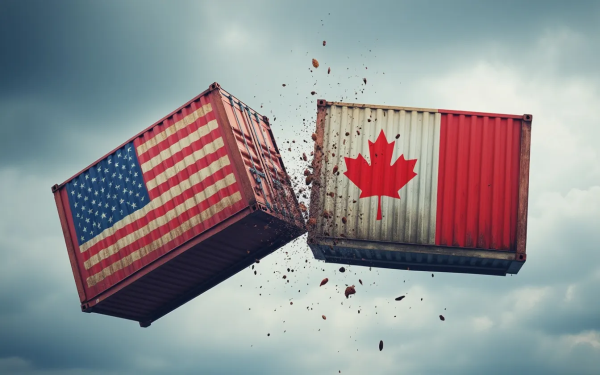
A revision to U.S. tariff collection rules on metals-intensive goods is exacting a steep price on Canadian manufacturers with cross-border supply chains. Powersports maker BRP Inc. (DOO) bore the brunt of the fallout Wednesday, with shares tumbling 35% after the company withdrew its full-year financial guidance.
The revised regime, which took effect April 6, imposes a 25% duty on the full value of products made “substantially” of steel, aluminum, or copper. This marks a sharp departure from the prior framework, which applied a 50% levy only to the embedded metal content. Snowmobiles and most of BRP’s off-road vehicle lineup fall under the new definition. The company now projects an annual tariff headwind exceeding $500 million, a dramatic increase from the roughly $90 million estimated just weeks earlier.
National Bank analyst Cameron Doerksen wrote that the scale of the cost increase “fundamentally changes” BRP’s earnings outlook and injects elevated uncertainty into the forecast. RBC Dominion Securities analyst Sabahat Khan noted that management’s near-term mitigation levers appear constrained; significant price hikes are not imminent, with the focus instead on drawing down U.S. inventory and pivoting volumes to non-U.S. markets.
Market attention is shifting toward the scheduled July 1 review of the United States-Mexico-Canada Agreement (USMCA). Doerksen observed that the tariff rule’s broader industry impact may have been an unintended consequence of efforts to streamline collections, leaving room for future adjustments. He cautioned, however, that there is no visibility on whether the U.S. administration will offer relief.
The cross-border exposure of Celestica (TSX: CLS) , Bombardier (TSX: BBD.B) , and Magna International (TSX: MG) keeps them sensitive to any dilution of USMCA exemptions. All three rely on efficient component flows between Canada and the U.S., and a shift in trade terms would translate directly into higher supply-chain costs.
Amid ongoing policy opacity, investors are rotating toward sectors less tethered to U.S. tariff actions. TC Energy (TSX: TRP) is positioned as a structural beneficiary of Canada’s export diversification push; its Nova Gas Transmission and Coastal GasLink pipelines are critical conduits to the LNG Canada terminal, reducing reliance on U.S. market access.
Bird Construction (TSX: BDT) offers a similar defensive tilt. The company’s backlog—anchored in LNG infrastructure and domestic data center projects—is driven by federal and provincial capital spending rather than cross-border trade flows.
With USMCA negotiations on the horizon, a cautious approach to manufacturers with concentrated U.S. sales exposure and production footprints in Canada or Mexico remains prudent. The BRP episode underscores how marginal changes in tariff calculation can force material downward revisions to earnings estimates. In evaluating holdings, investors should prioritize balance-sheet durability—namely cash positions and manageable leverage—while assets linked to Canadian energy autonomy and infrastructure offer a comparatively insulated risk profile in the current environment.