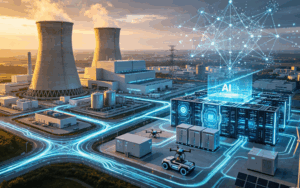

Big Tech just rewired its playbook. Asset-light is out; infrastructure-heavy is in. The result: a historic cash flow squeeze as hyperscalers race to lock up data centers, power, and GPUs to win AI. A spending surge already measured in the hundreds of billions has pulled free cash flow down toward decade lows, even as shares trade at premium multiples that assume immaculate AI outcomes. Markets blinked as geopolitical risk resurfaced and oil jittered, reminding investors the cost of capital and energy still matter. The bet is clear: pour cash into AI now, harvest later. The risk is clearer: later may arrive slower, and pricier, than models imply.
The broader tape isn’t giving tech a free pass this week. The S&P 500 slipped as materials and energy lagged while investors waited for clarity on a proposal aimed at reopening the Strait of Hormuz and ending the war in the region. Earlier optimism on a potential Iran peace pathway cooled, and with it a key pillar of the “lower energy, lower inflation” narrative. That matters for hyperscalers. High AI spend colliding with sticky power and capital costs tightens margins. Mega-cap tech still anchors the market, but the leadership is narrower and more fragile when free cash flow is falling just as capex crests. The market is paying for growth and visibility; right now, it is only getting one of the two.
For Microsoft (MSFT), Amazon (AMZN), Alphabet (GOOGL), and Meta (META), the capex line has become the only chart that matters. Data center buildouts, long-term power purchase agreements, and silicon commitments are pulling billions per quarter from cash flow that, until recently, funded buybacks and cushioned earnings dips. Analysts now peg combined AI-related spend topping $1 trillion by 2027, with as much as $700 billion front-loaded into 2026. That scale dwarfs prior cloud cycles. The investment case says operating leverage will snap back as AI services graduate from pilots to priced products. The accounting says depreciation and amortization will be lapping this spend for years. Investors conditioned to one-click cash waterfalls are getting a crash course in industrial balance sheets.
What changed is the business model. Training frontier models and serving inference at global scale is less like spinning up another SaaS module and more like running a utility. The inputs are heavy and non-negotiable: land, transformers, water, and steady electricity. Nvidia (NVDA) is the toll collector now, with follow-ons from AMD and custom silicon pushing the supply chain harder. Hyperscalers are also funding fiber, cooling innovations, and next-gen networking to claw back cost-to-serve. Returns can be compelling, but the payback curve is lengthening, and the margin for error is shrinking. That has consequences for capital return. Meta already lifted its capex guide to chase AI relevance. Alphabet’s pace has accelerated. Microsoft is signaling sustained elevated spend. Amazon is re-accelerating AWS investment. The buyback machine has competition: the build.
Revenue has to pull forward quickly to justify this burn. Microsoft’s Copilot attach and Azure AI workloads are the cleanest path today, but pricing, usage caps, and GPU scarcity cap near-term upside. At Alphabet, the question is whether AI-native search can defend ad yield without bloating cost of revenue. For Meta, AI’s payoff runs through better ad relevance and a long-shot bet on AI assistants at scale. Amazon needs enterprise AI adoption to pull through more compute, not just bursty training. Each of these is executable, but they are not guaranteed. Training costs are front-loaded; inference costs persist. If utilization disappoints or customers balk at price, hyperscalers eat the spread. That is why free cash flow matters more than headline revenue beats this year.
AI is a power story as much as a compute story. Data center megawatts are the new constraint, with grid interconnections queued for years in key U.S. markets. Any flare in oil or gas prices complicates the calculus, especially as backup generation and power market hedges become core to planning. This week’s swings tied to the Middle East underscore the fragility of the energy path. Even if crude stays range-bound, local electricity pricing and permitting timelines can delay capacity and inflate costs. That bleeds into unit economics for AI services. Hyperscalers are racing to lock long-term renewable contracts, experiment with alternative cooling, and site campuses near cheap hydro or nuclear. It helps, but it doesn’t erase the reality: AI margins are now partially a commodity spread.
Big Tech stocks still trade as if cash conversion will normalize quickly. Maybe it will. But the market is vulnerable to any signal that capex intensity outstrips revenue conversion into 2026. Bridgewater’s Ray Dalio calls this a period of great turbulence, citing debt, politics, and AI disruption. Translate that into equity math: a higher-for-longer rate regime, episodic volatility around geopolitics, and regulators circling AI usage and energy footprint. In that world, elevated capex and lower free cash flow push buybacks down the priority stack, while debt issuance creeps up. Multiples compress if visibility blurs. The hyperscaler bull case still runs; the air just gets thinner.
The spend isn’t happening in a vacuum. Nvidia and its ecosystem, from optics to advanced packaging, sit upstream of hyperscale budgets. Equipment makers and chip foundries are booking out capacity, while data center landlords and power developers see multiyear demand. Those exposures work as long as hyperscalers keep the pedal down. If AI ROI disappoints or if cost inflation bites, the pullback will ripple quickly through these supply chains. On the flip side, companies that help lower power draw, boost utilization, or accelerate networking can gain share of wallet. Watch for capex mix shifts toward efficiency as much as raw capacity. The winners won’t just sell more; they will make what already exists cheaper to run.
Guidance language will tell you when confidence wobbles. Look for tighter capex ranges, explicit commentary on cost-to-serve trends, and any hints that customer AI pilots are graduating to paid, scaled deployments. Monitor free cash flow and net leverage against buyback cadence; rising debt to fund AI is a tell. Energy line items and disclosures on power procurement will matter more this year than they ever have for software-adjacent names. On product, watch attach rates for Copilot, AI-enhanced search monetization, and AI-driven ad pricing or conversion. The market needs evidence that the revenue slope is steep enough to catch a spending curve that is getting steeper by the quarter.
The single biggest market risk is not that hyperscalers keep spending. It is that they pause. A collective or even staggered pullback would ripple through semis, equipment, utilities, and REITs, pressuring growth proxies that have led the tape. It would also flag that AI monetization is slower than hoped, forcing investors to rerate earnings power lower while the cost base remains elevated. For now, management teams are all-in, and the pipeline of GPUs and power deals suggests momentum through 2026. But the bar is high, the bills are due, and patience is finite. AI doesn’t have to fail to dent returns; it only has to take longer.
The bottom line for MSFT, AMZN, GOOGL, and peers: the AI buildout is real, the strategic stakes are high, and the checks are finally big enough to change how these companies generate and return cash. Free cash flow is the scoreboard until AI revenue catches up. If it does, these are stronger, more defensible businesses. If it doesn’t, the market may rediscover how quickly premium multiples can reset when the asset-light era ends.