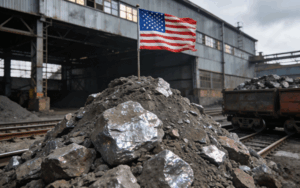
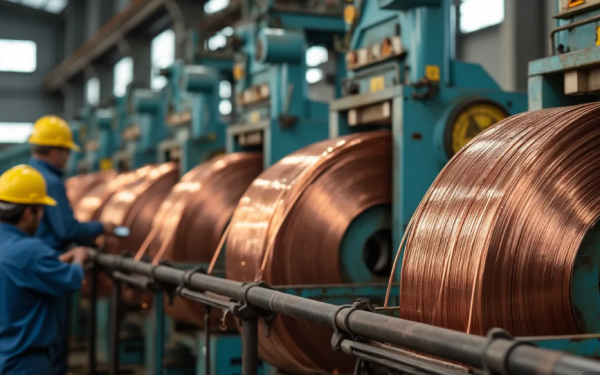
The copper squeeze on the London Metal Exchange has intensified, with the cash contract commanding a premium of $434 a tonne over three-month futures — the widest in five years. The August-to-September spread reached $370 a tonne, the steepest one-month gap since the emergency intervention of 2021. Cash copper traded near $14,500 a tonne, close to its all-time high, while the benchmark three-month contract stood above $14,100, up almost 14% this year. LME stockpiles fell for a 42nd consecutive day to 204,975 tonnes, the longest run of declines since 2014, with nearly half already earmarked for withdrawal.
Historically, sharp copper rallies were read as a barometer of accelerating global growth. This time is different. The move is being driven by a series of supply failures. The Democratic Republic of Congo has officially banned exports of copper and cobalt concentrates, tightening feedstock availability. Heavy rain in Chile forced Los Pelambres to halt operations and led Antofagasta to cut annual output guidance by about 5%, while Codelco’s Andes Norte project has been delayed until 2029. In Indonesia, the Gresik smelter has been shut because of furnace damage, removing roughly 342,000 tonnes of annual cathode capacity. Chile’s national production remains stuck near 5.5 million tonnes, below its 2018 peak.
In the April 2026 edition of METALS 100, Enrico Gay, CEO of Algo Grande Copper Corp. (TSXV: ALGR | OTC: ALGRF | FRA: KM00), provided a detailed overview of the company’s latest developments and future direction. Algo Grande Copper is a North American mineral exploration company focused on advancing the Adelita project in the Arizona-Sonora copper belt. The project is district-scale and encompasses multiple mineralized systems with copper, silver, and gold development potential.
Demand is not coming from traditional industrial expansion. China’s grid investment rose 13% in the first half, and Beijing has announced a grid upgrade programme worth around $574 billion. Data centres and power infrastructure are now a bigger marginal driver of copper than conventional manufacturing. Michael Widmer, head of metals research at Bank of America, said the move is mainly supply-driven, with weak mine growth and weather disruptions in Chile adding further constraints. Potential U.S. Section 232 tariffs and China’s crackdown on scrap copper are also disrupting supply.
Traders have been pulling metal out of LME warehouses to ship to the United States to avoid possible tariffs and to China to fill smelter feedstock gaps, draining available stocks. Analysts warn that if inventories continue flowing east and west, Dr Copper’s panic could return. BMI has lifted its 2026 average copper forecast to near $13,500 a tonne but says the U.S. tariff decision remains the key short-term variable, with longer-term bullish fundamentals intact.
“It is definitely a new situation for Dr Copper,” said William Osnato, an analyst at Barchart. Copper is approaching record levels not because the global economy is overheating, but because of a structural collision between a supply crisis and electrification demand.