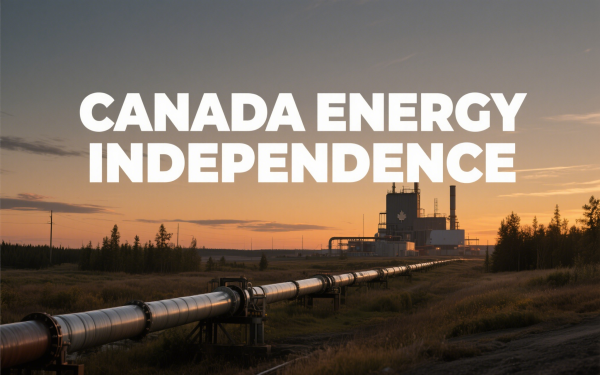
Prime Minister Mark Carney announced Thursday that Ottawa and Alberta will meet Friday to advance plans for a major new crude oil pipeline capable of transporting at least 1 million barrels per day to new markets, marking a historic turning point after a decade of internal debate that has stifled Canada’s energy ambitions.
Carney also confirmed a Reuters report that his government will unveil details of a new industrial carbon pricing agreement with Alberta, a long-awaited concession that could end years of bitter tensions between the federal government and Canada’s energy heartland.
The accelerated push for energy infrastructure comes as global oil markets are roiled by the Iran war and disruptions to Persian Gulf exports through the Strait of Hormuz. Middle Eastern crude has become increasingly difficult, expensive and politically risky to secure, catapulting Canada’s stable supply into unprecedented demand.
The market signal has become impossible for Ottawa to ignore. Earlier this month, oil producers committed at least 400,000 barrels per day to another proposed export pipeline linking Canada to the U.S. through Montana and Wyoming. Backed by South Bow Corp. and Bridger Pipeline, that project will initially carry 550,000 bpd and eventually scale to more than 1.1 million bpd.
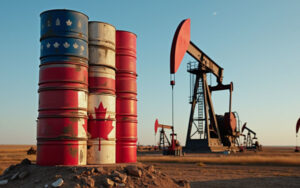
For Canada, which holds the world’s third-largest oil reserves, pipeline capacity constraints have been a decade-long drag on the industry. The country currently produces roughly 5.5 million bpd of crude and is on track to reach 6.1 million bpd by 2030. Yet landlocked barrels have repeatedly depressed Canadian crude prices whenever takeaway capacity tightens.
Existing expansions have provided only partial relief. The Trans Mountain expansion helped ease bottlenecks, while Enbridge is also expanding its network and Trans Mountain could see further upgrades. But these efforts have fallen far short of meeting growing production needs, prompting the federal government’s new commitment to large-scale export infrastructure.
Beneath the economic pressures lies a profound political shift. Carney’s compromise on industrial carbon pricing suggests the federal government has finally accepted a truth it resisted for years: Canada cannot become an energy superpower while simultaneously making it impossible to build energy infrastructure.
The move also reflects growing Canadian anxiety over its reliance on the U.S. market. More than half of all U.S. oil imports come from Canada, but bilateral trade talks have stalled, raising fears of reduced export revenues. This has intensified Ottawa’s push to diversify its customer base and reduce its dependence on its southern neighbor.
Carney has previously said his government is seeking to boost the economy through large-scale investments and faster regulatory approvals, while reducing reliance on the United States. Canada’s future growth, he has stated, will be driven by infrastructure development and resource strategy.
Amid shifting global trade patterns and significant uncertainty, Canada and Alberta are building a new partnership to make Canada an energy superpower, reduce emissions and diversify our export markets, Carney told reporters.
With the federal government now fully backing major energy infrastructure projects, Canada is finally poised to put a decade of internal division behind it and seize the historic opportunity presented by the reshaping of global oil markets to unlock the full potential of its vast petroleum reserves.