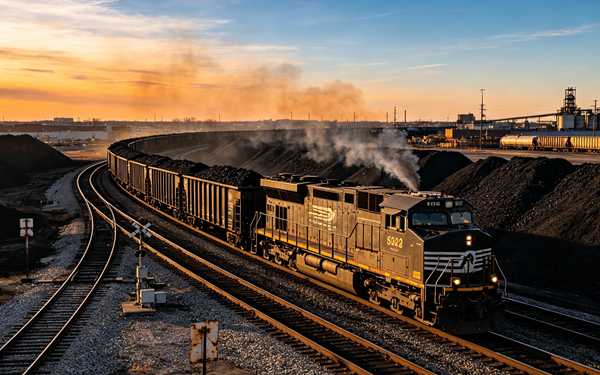
Coal beneath federally managed public lands holds enough resources to meet current U.S. consumption for at least six centuries, according to a newly released assessment from the U.S. Geological Survey, providing fresh scientific backing for the Trump administration’s aggressive push to revitalize the coal industry while deepening the rift between energy policy and global climate pledges.
The USGS report estimates 4.2 billion short tons of reported reserves tied directly to active mining operations on federal lands, plus an additional 355.8 billion short tons of available coal resources still in the ground. In 2024, the 34 federal-land coal mines produced more than 261 million short tons, accounting for 51.06 percent of the nation’s total coal output.
Resources are overwhelmingly concentrated west of the Mississippi River. Wyoming alone hosts 14 federal coal mines and produced 188.3 million short tons last year—nearly 72 percent of all federal-land production. The North Antelope Rochelle mine in the Powder River Basin ranks as the world’s largest coal mine by reported reserves, holding 1.3 billion short tons and churning out 59.8 million short tons in 2024. The Powder River Basin contains roughly 180.9 billion short tons of available subbituminous coal, representing 50.75 percent of the total available federal resources in the conterminous United States.
The policy push is accelerating in parallel. Interior Secretary Doug Burgum said in a statement that “American Energy Dominance is more important than ever, and so is beautiful clean coal’s role in the production of electricity needed to fuel our future prosperity.” President Donald Trump earlier signed Executive Order 14261 directing a review of federal coal resources, and Burgum has added metallurgical coal to the 2025 List of Critical Minerals, underscoring its strategic role in steelmaking. The USGS report also calls for expanded geological mapping in Alaska, where identified available coal resources are estimated at no less than 140 billion short tons and undiscovered resources could reach as much as 5.5 trillion short tons.
Of the 34 active mines on federal lands, 29 produce thermal coal for power generation, three in Alabama supply metallurgical coal for steelmaking, one Colorado mine feeds the cement industry, and one Utah mine remains idled. The Trump administration has committed more than $1 billion to extend the operating lives of coal-fired power plants and expand production capacity.
The report lands amid a sharp policy divide. Climate scientists maintain that deep cuts in coal, oil, and gas consumption are essential to limiting global warming and avoiding more severe climate impacts. The USGS itself notes that future assessments will need to examine environmental, societal, and technical constraints that could affect how much of this vast resource can ultimately be developed.