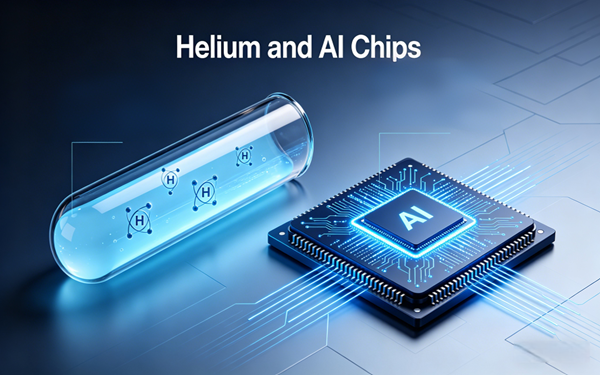
What most people associate with party balloons has emerged as the unforeseen bottleneck threatening the global artificial intelligence industry. An Iranian drone attack on Qatar’s Ras Laffan Industrial City on February 28 knocked out one-third of the world’s helium supply, exposing a critical vulnerability in the multi-trillion-dollar AI supply chain.
The shock has sent spot prices doubling in weeks, forced chipmakers to monitor inventories closely and handed unprecedented pricing power to a small group of industrial gas giants.
Ras Laffan is the world’s single largest helium production hub. QatarEnergy declared force majeure on all exports days after the strike. Compounding the crisis, the Strait of Hormuz—Qatar’s only maritime export route for helium—quickly became a contested waterway where commercial vessels face seizure and naval ships exchange fire.
Taiwan Semiconductor Manufacturing Co. (TSM), which consumes approximately 500,000 cubic feet of helium annually for its leading-edge nodes, has activated emergency inventory monitoring. South Korea’s Samsung Electronics and SK Hynix, which sourced 64% of their helium from Qatar in 2025, are running on a six-month stockpile that will expire between June and July. U.S. distributor Airgas declared force majeure on helium shipments in April.
Helium performs four core functions in advanced semiconductor manufacturing that cannot be replicated at scale:
The 3nm and 5nm nodes used to manufacture Nvidia’s (NVDA) Blackwell and Rubin GPUs consume significantly more helium per wafer than older processes. Building new helium extraction and liquefaction infrastructure takes a minimum of two to three years.
Air Products and Chemicals Inc. (APD) and Linde PLC (LIN) control the majority of the global industrial helium supply and distribution network, giving them absolute pricing power over semiconductor customers.
Air Products reported better-than-expected Q1 2026 results on April 30, raising its full-year adjusted earnings per share guidance to $13.00–$13.25. The company explicitly cited helium price strength as a direct tailwind and has activated domestic U.S. storage facilities and boosted liquefaction capacity.
Among chipmakers, Micron Technology Inc. (MU) stands out as the best-positioned memory producer.
Global helium production is dominated by the U.S. (42.6%) and Qatar (33.2%). South Korea imports 64.7% of its industrial helium from Qatar, all of which must transit the Strait of Hormuz.
Micron operates two mature fabs in the U.S. with a third under construction in New York. In 2024, the company signed a long-term agreement with France’s Air Liquide, which is investing $250 million to build a dedicated industrial gas facility in Idaho. Air Liquide, a 30-year partner of Micron, sources most of its helium from U.S. natural gas refineries.
For investors betting on the AI supercycle, there is no need to exit positions in Nvidia or TSMC. However, the crisis has revealed that companies storing, liquefying and distributing helium have become some of the market’s most important infrastructure plays.
In the memory sector, Micron is well-positioned to gain market share thanks to its lowest dependence on Qatari helium and strong financial position (41.5% net profit margin and 0.15 debt-to-equity ratio). All three major memory manufacturers have seen their shares rise 70%-90% year-to-date. SK Hynix Chairman Chey Tae-won believes the AI-driven memory shortage will persist until 2030, coinciding with the expected completion of repairs to Qatar’s facilities.