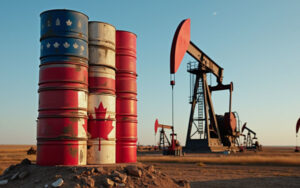
Oil futures are calm while the world burns through its buffer. That is not stability. It is a countdown. When a pressure vessel runs hot and the gauge looks steady, a good engineer checks the welds. The Gulf is that pressure vessel. The weld is the Strait of Hormuz. Markets are betting the seam holds.
Look at the oil curve and you see managed expectations. Prices imply a disruption that resolves on schedule. Volatility is contained. This is the old habit of extrapolating from regimes that rewarded patience and carry. But chokepoints break models built for smooth flows. The value of time, location, and certainty spikes when logistics turn nonlinear. A future barrel is not the same good as a barrel that can clear a strait today. The Financial Times flagged this disconnect. Futures markets are sanguine even as inventories fall. That is the classic error of treating energy as a homogenous commodity instead of a system of pipes, hulls, and risks where timing is everything.
Nature hates monocultures because they invite collapse. Global oil still runs a monoculture through Hormuz, the narrow channel that moves a large share of the world’s seaborne crude and products. With war throttling flows and ships avoiding the strait, Middle East output cuts have deepened and global supply is lower by a material percentage. Some barrels can detour via pipelines to the Red Sea or Oman, but those routes are narrow and already busy. A pipeline is not a magic wand. It has a rated capacity, maintenance windows, and political exposure at each end. You cannot reroute a river by committee in a week.
We are drawing stocks at a record pace. That is not conjecture; multiple data series now show the buffer shrinking fast. Inventory is not a cushion forever. It is ammunition. When the stock-to-flow ratio drops toward critical levels, the price elasticity of supply and demand worsens dramatically. Small outages create big moves. Retail buyers fill tanks. Refiners hoard. Governments debate tapping reserves again. Each action makes the buffer thinner. If you rely on inventory to smooth the shock, you are betting the shock abates before the buffer empties. Time is not neutral here. It is a decaying asset.
In strategists’ language, the Gulf is a repeated game with imperfect information. Each convoy, sanction tweak, and strike is a move on the escalation ladder. The longer the game runs, the higher the odds of a misread or an accident. Shipping insurers ration coverage. Reflagging and shadow fleets change the composition of risk without reducing it. Deterrence is a balance that drifts. You see it first not in headlines but in basis spreads, freight rates, and odd routing choices on AIS screens. Markets often price the median path. But with private signals and diverging incentives, the median path is a mirage. In games like this, one tail dominates outcomes.
Investors learn the wrong lesson from calm periods. Stability breeds trades that harvest small premiums by selling optionality. The carry looks safe until it compounds fragility. Energy disruptions are not normally distributed events. They follow a mixture of quiet regimes and rare, violent breaks. The 1973 embargo, 1979 revolution, and 1990 invasion were different triggers with the same structure: chokepoint pressure meets inadequate buffers. The mistake is to assume a closed strait reopens on schedule because most disruptions have. Independence of draws does not survive geopolitics. A decade of quiet is not nine times as safe as a year. It can be nine times as brittle.
There is a habit of comfort in naming pipelines as backstops. Yes, the Saudi East West line and the UAE link to Fujairah can move meaningful volumes outside Hormuz. Yes, Iraq can push crude north at times. But these systems operate near practical constraints. They require power, crews, spare parts, and political coordination when both sides are under stress. The Red Sea has not been a sanctuary for shipping. Insurance costs and transit times rise. Quality mismatches complicate refinery slates. The world could accept different crude grades and product yields, but not overnight. Every work-around adds friction and delay. The arithmetic is the point: even if all known bypasses run flat out, they offset only a slice of normal Gulf flows. A six percent global supply hit in a tight system is not a rounding error.
Resilience is built, not assumed. In energy, that means redundant routes, higher base inventories, and demand-side flexibility that can throttle without killing growth. It means paying for spare capacity we hope not to use, the way engineers spec a bridge for the truck that rarely comes. It means contracts with real optionality rather than illusions of just-in-time. And it means a broader portfolio of fuels and storage forms so no single chokepoint dictates global margins. Policymakers do not like paying for idle steel or holding more stocks. CFOs do not like carrying working capital. But the premium for redundancy is small compared to the cost of forced adaptation under duress.
This is not a call to hoard barrels or punt on headlines. It is a call to recognize when the market is selling insurance too cheaply in a system with rising state-contingent risk. The traits to value are simple and unfashionable: low leverage, ample liquidity, logistical flexibility, and real options embedded in supply chains. Be wary of exposures that look diversified on paper but roll up to the same chokepoint in practice. Avoid models that require mean reversion on a schedule. Respect path dependence. In oil, the second-order effects matter as much as the headline. Product cracks, freight, and inventory days-of-cover can move more and earlier than the front month price. Those are the canaries that tell you whether the weld is holding.
Markets misread fragility because it hides in plain sight. A strait that always stayed open became a base case. A buffer that was always there became a constant. Today both are variable. The futures market can prefer tidy curves. The real world prefers physics and game theory. If this is only the start of the Gulf crisis, the costliest error is not missing a price target. It is assuming the system is elastic when it is not.