

SLAM Exploration Ltd. (TSXV: SXL)
‘Exploring for critical elements and precious metals in New Brunswick, Canada.’
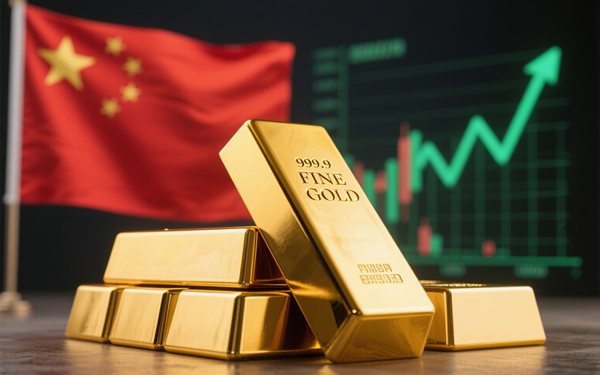
China’s capital markets have reached a historic turning point. The Huaan Yifu Gold ETF has overtaken the Huatai-PineBridge CSI 300 ETF to become the country’s largest exchange-traded fund, marking the first time a gold product has ever topped the rankings of China’s ETF industry. With assets of roughly 90 billion yuan ($13 billion), the gold fund now edges out the 83 billion yuan stock benchmark that long served as the flagship for Chinese equities and a favorite vehicle for state-backed market intervention.
The changing of the guard was not driven by a rally in bullion. In fact, the gold ETF itself has shrunk from a peak of about 136 billion yuan earlier this year, and gold prices have fallen over the same period. Rather, the crossover reflects an even more dramatic exodus from equities. The CSI 300 ETF once ballooned to approximately 440 billion yuan when the so-called “national team” of state-linked funds aggressively bought shares to stabilize the market. Since then, it has suffered relentless outflows, losing roughly 18.5 billion yuan last week alone — among the heaviest redemptions in Asia. With a smaller relative drawdown, the gold fund quietly claimed the crown.
The flow of money paints a clear picture of China’s shifting risk appetite. A languishing property sector, choppy equity markets, and the gradual retreat of state support have all weighed on investor confidence. Although select technology indices have hit fresh records, the CSI 300 Index has gained only about 5% this year, dramatically lagging the MSCI Asia Pacific Index’s more than 20% surge. Meanwhile, low deposit yields and capital controls limit offshore diversification. Against that backdrop, a liquid, exchange-traded gold product has emerged as a clean one-stop hedge against currency weakness, financial repression, and policy uncertainty — drawing savings that might otherwise have few places to go.
This rotation toward safety extends well beyond gold. The third- and fourth-largest ETFs in China are now the HFT CSI Short-Term Note ETF and the Hwabao WP Cash Tianyi Money Market ETF, underscoring a broader stampede into fixed-income and cash-management products. Gold’s ascent to the top spot is simply the most potent expression of that defensive rush.
Official sector activity echoes what private investors are doing. China’s central bank has added to its gold reserves for 20 consecutive months, purchasing 10 tonnes in May alone — its largest monthly increase since late 2024 — to bring total official holdings to 2,331 tonnes, about 9% of total reserves. Globally, Poland has bought 64 tonnes so far this year, Uzbekistan holds an extraordinary 87% of its reserves in gold, and a World Gold Council survey shows 89% of central bankers expect global gold reserves to rise over the next 12 months. Sovereign reserve managers and Chinese retail investors, responding to similar anxieties, are rotating into bullion in lockstep.
Underpinning this trend, the infrastructure of the gold market itself is tilting eastward. Hong Kong has just launched its long-planned precious metals clearing and settlement system, aiming to transform from a passive price taker into an active participant in global price discovery, with 11 major banks — including HSBC, JPMorgan, Citi, UBS, and Bank of China — providing initial liquidity. In the same week, Citi became the first new member of London’s precious metals clearing system in a decade. What looks like a back-office update is in fact a powerful signal: major Western institutions are securing direct roles in bullion settlement just as official and private capital converge on gold.
The symbolism is impossible to ignore. When China’s biggest ETF no longer tracks the stock market but is backed by physical gold, it signals more than a mere change in rankings. With confidence in property, equities, and repeated official rescue efforts eroding simultaneously, Chinese households are redefining what counts as a safe asset. Three forces that normally operate independently — sovereign reserves, domestic ETF flows, and the plumbing of the global bullion market — all turned toward gold at the same moment. Behind the convergence lies a slow but profound recalibration of the world’s reserve-asset architecture.