Pembina Pipeline Corp. (TSX:PPL) may hold just a 10 percent stake during construction, but it is the Calgary-based infrastructure company that is capturing the market’s attention as Alberta formally pitches Ottawa on a second West Coast oil export pipeline.
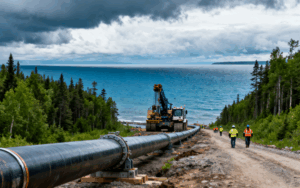
The proposal, submitted to the federal major projects office, envisions a new line tracing the Trans Mountain corridor to carry heavy crude from the oil sands directly to Pacific tidewater. No official budget has been released, but the project is being compared to the Trans Mountain expansion — a saga that ended with a final price tag of C$34 billion, more than quadruple its original 2017 estimate. This time, however, the financial playbook is being rewritten: federal and provincial Crown corporations will shoulder 90 percent of the equity, while Pembina writes itself a deliberately modest ticket.
Prime Minister Mark Carney called the pipeline a “once-in-a-generation nation-building energy infrastructure.” Behind that rhetoric sits a heavily public balance sheet. Trans Mountain Corp., the federal Crown that built and now operates the expanded 890,000-barrel-per-day system, will serve as developer, builder and operator, leaning on its existing right-of-way, workforce and systems. Alongside it, the Alberta Petroleum Marketing Commission — the province’s commercial arm — is stepping into an equity role for the first time, moving well beyond its traditional function of committing barrels to early-stage projects. Together, these two state entities will absorb virtually all the financing and construction risk.
Pembina, by contrast, has taken a characteristically measured position. Under a non-binding heads of agreement, the company holds a 10 percent interest during the building phase, with an option to double its stake to 20 percent once oil begins to flow. Chief Executive Scott Burrows emphasized that the decision would be “evaluated through the same disciplined lens we apply to every capital decision,” adding that the structure “preserves our financial flexibility and incorporates meaningful protections.” In a sector still scarred by the Trans Mountain expansion’s cost overruns, that kind of restraint has turned Pembina into a poster child for capital discipline.
Yet the company’s influence runs far deeper than its equity slice. Two strategic advantages explain why a 10 percent stake can punch so far above its weight.
Bitumen must be blended with condensate or similar light liquids to move through a pipeline. Richard Masson, former head of the Alberta Petroleum Marketing Commission, warns that if all planned oil sands export pipelines are built, Canada will need to more than double its diluent production. Pembina happens to be one of Western Canada’s largest natural gas processors, operating plants that strip out exactly those liquids. By controlling a critical upstream input for pipeline throughput, Pembina transforms from a passive shipper into an indispensable supplier — one whose bargaining power and midstream profit potential go well beyond a simple equity stake.
Pembina’s sprawling network of gas gathering, processing, fractionation and its advancing Cedar LNG export terminal with the Haisla Nation showcase an integrated midstream capability that governments do not possess. Carney acknowledged as much, stating that Pembina brings “capital discipline and operating expertise — and that enriches it.” In an era of mega-project bloat, operational credibility is a scarce and valuable asset.
Markets have already begun to reprice that scarcity. Pembina shares have risen roughly 32 percent over the past year, giving the company a market capitalization near C$39 billion. The board recently lifted the quarterly dividend by 3.5 percent, locking in a yield around 4.5 percent. The hike came on the back of first-quarter 2026 adjusted EBITDA of C$1.1 billion and adjusted cash flow from operations of C$790 million — numbers that comfortably cover the payout. Full-year EBITDA guidance sits between C$4.35 billion and C$4.55 billion, supported by stronger marketing margins and newly completed assets such as the Wapiti expansion and the K3 cogeneration facility.
For income-oriented investors, the structure is a rare gift: governments take the construction and execution risk, while Pembina supplies the diluent, the operational know-how and the financial discipline — then collects a rising stream of tolls, processing fees and dividends. As one industry observer put it, Ottawa and Edmonton are building the road; Pembina gets to run the tollbooth. And with an option to double down once cash flows are steady, the company has positioned itself to capture a disproportionate share of the upside from a “once-in-a-generation” energy corridor — all while sticking firmly to its own financial guardrails.