Weekly Market Recap (August 8) – Trump Targets Graphite, Tantalum and Boron in $3 Billion Critical Minerals Push
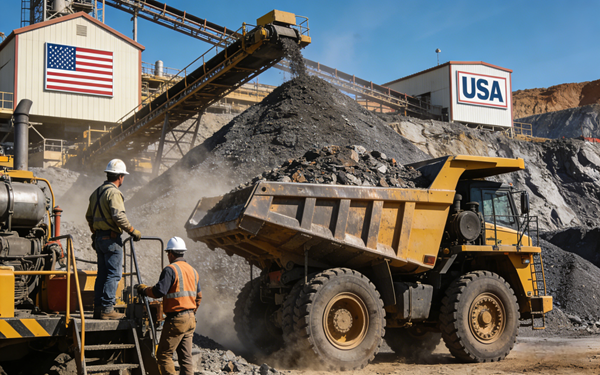
President Donald Trump, convening executives from the world’s largest mining companies on Friday, unveiled a sweeping $3 billion investment package to accelerate domestic critical mineral production and processing. At the center of the announcement, the U.S. Export-Import Bank disclosed $58 million in new loans, singling out graphite, tantalum, niobium and boron as priority materials in the effort to bolster supply chains.
“Critical mineral security is national security,” said Ex-Im Bank Chairman John Jovanovic, adding that the financing is designed to fortify supply chains, restore industries that support well-paying American jobs, and shield the public from supply shocks.
First Phosphate Corp. (CSE: PHOS, OTC: FRSPF, FSE: KD0), a mineral development company dedicated to extracting and purifying phosphate for lithium iron phosphate (LFP) battery cathode active material production, had its CEO and Director John Passalacqua elaborate on the company’s latest advancements in a METALS 100 interview, where he emphasized the standout results of the Bégin-Lamarche project’s PEA — including a CAD 2.1 billion net present value and strong internal rate of return — along with the firm’s deployment of advanced phosphoric acid technology and strategic partnerships to bolster its value chain and competitive position in the fast-growing LFP battery sector.
The $58 million facility breaks down into three targeted loans. Westwater Resources will receive $25 million to advance its graphite mine and processing facility in Alabama. Graphite remains the largest metal by volume used in lithium-ion batteries; while the U.S. currently produces some synthetic graphite from petroleum coke, battery manufacturers choose between natural and synthetic grades based on a range of factors.
Global Advanced Metals, a privately held company, was awarded another $25 million to expand processing capacity for tantalum and niobium — two metals that the U.S. does not mine domestically, leaving it reliant on foreign sources. The firm extracts the ores in Australia and processes them in Pennsylvania. Tantalum is essential for capacitors in smartphones, automobiles and other electronics, while niobium serves as a strengthening alloy in steel for pipelines and aircraft.
5E Advanced Materials secured $8 million to boost boron output. Boron was added to the U.S. government’s critical minerals list last year and is used in nuclear energy as well as defense products such as body armor. The U.S. imports the vast majority of its boron needs; 5E’s California project is slated to begin commercial production in 2028.
Beyond the Ex-Im Bank loans, the broader $3 billion package includes a $1.4 billion loan from the Defense Department to Sila Nanotechnologies Inc. for next-generation battery technology, and $400 million from the Pentagon to expand production of scandium in Australia — a metal vital to aerospace and defense. Niron Magnetics Inc. is set to receive $150 million to advance rare-earth operations in Minnesota. The Export-Import Bank is also working to provide more than $1 billion in financing for Ivanhoe Electric Inc.’s Santa Cruz copper project in Arizona, and more than $180 million will be directed toward mining education and training programs, which Trump said would “train the next generation of American miners.”
The meeting at the State Department drew leaders from Rio Tinto Group, BHP Group, Freeport-McMoRan Inc., MP Materials Corp., USA Rare Earth Inc., Energy Fuels Inc., US Antimony Corp., Sunrise Energy Metals Ltd. and The Metals Company, among others.
Trump said the investments would create thousands of jobs, promote economic stability and security, and ensure the United States “is never again reliant on hostile foreign nations for the resources our country needs to dominate in the future.” He added that the nation was reclaiming its “rightful place as the minerals superpower of the world.”
Copper
Graphite
Phosphate
Rare Earth