
Alibaba shares jumped after the company unveiled a new AI accelerator it says is China’s most powerful, while Meta’s stock got a fresh jolt from a surprise consumer AI hit that revived optimism across the sector. The twin catalysts landed as investors looked ahead to a Trump–Xi summit later this week, with AI and trade on the table, turning Tuesday into a live stress test for sentiment around both Chinese and U.S. tech.
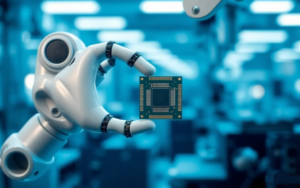
The headlines are helping pull Alibaba back into the center of the global AI trade. At its annual Apsara Conference in Hangzhou on Tuesday, Sept. 22, 2026, the company introduced the Zhenwu V900 AI accelerator from its T-Head chip unit. Alibaba called it “China’s most powerful AI chip,” and said the new chip delivers three times the performance of its predecessor, the Zhenwu M890. The market heard more than product talk: it heard a company trying to sharpen its own AI stack at a moment when hardware capacity has become a strategic race.
The stock reaction was immediate. Alibaba’s Hong Kong-listed shares rose as much as 5.1% intraday Tuesday, far outpacing the 0.8% gain in the Hang Seng Tech index. The U.S.-listed ADR closed the session up 2.22% at $115.75, according to the market data in the fact pack. That move matters because it puts fresh attention on whether Alibaba can turn its cloud and chip ambitions into a credible rival narrative in a market still dominated by U.S. names and still skeptical of Chinese tech execution.
Alibaba is not selling the V900 as a modest update. CEO Eddie Wu said, “The Zhenwu V900 is the most powerful AI chip in China today, delivering three times the performance of its predecessor, the Zhenwu M890.” He also said, “We anticipate significant growth in annual AI chip shipment volumes.” Those are the kind of lines investors listen to when they want to understand whether a company is preparing for a larger buildout, not just a single launch.
The chip story comes with scale. A single V900 cluster can support up to 500,000 cards for training and inference of frontier models, according to the fact pack. That scale is the real point of the announcement. In AI, the chip itself is only part of the story; what matters is whether the hardware can support the model training and inference workloads that define the next generation of products. Alibaba is signaling that it wants to be taken seriously on both sides of that equation.
Wu also drew a longer-term map for the infrastructure buildout. He set a target of 20 gigawatts of Alibaba Cloud data center capacity by 2032. That kind of target speaks to power, cooling, and capital intensity as much as software ambitions. It also suggests Alibaba is thinking in multi-year cycles, not the quarter-to-quarter rhythm that often drives Chinese tech trading. For investors, the question is less whether the company can make a newsy chip debut and more whether it can sustain the spending and execution needed to make the debut matter.
Alibaba also said it plans to train a new model with 5–10 trillion parameters, compared with 2.4 trillion for its Qwen 3.8 Max. That is a meaningful jump in ambition, at least on paper, and it fits the broad industry trend toward bigger models that require more compute, more memory, and more energy. But the company is still talking about plans and targets, not a deployed product that has already proven itself in the market.
Mass production and commercial release of the V900 are slated for Q1 2027, which means investors are looking at a future milestone, not an immediate revenue driver. That timing is important. It gives the stock a story, but not yet the hard proof that the story will translate into operating results. In the meantime, the announcement may help Alibaba argue that it is not just a user of AI infrastructure, but also a builder inside China’s tightening technology ecosystem.
The broader backdrop is doing some of the lifting. The event came just before a Trump–Xi summit scheduled for Thursday, and after U.S.-China AI and trade talks in New York. That political calendar matters because AI hardware sits at the intersection of industrial policy, export controls, and strategic competition. When the diplomatic stakes are high, any Chinese company that can present itself as advancing domestic capability tends to get extra attention from investors looking for a local winner.
Alibaba was not the only stock getting a lift from AI optimism. Meta shares rose about 11% after its AI agent Muse topped download charts, according to the fact pack. That move matters because it gives the market a separate reason to believe AI can still drive user engagement and consumer excitement, not just enterprise spending and infrastructure buildouts. In a sector where narrative often moves faster than fundamentals, a chart-topping app can matter as much as a chip announcement.
For Alibaba, the Meta move is useful context. It reinforces the idea that investors are once again willing to reward AI stories, even when the details differ sharply between companies. Meta’s boost came from product traction. Alibaba’s came from hardware, cloud, and model ambition. One is about immediate popularity; the other is about strategic capacity. Together, they helped revive a broader sense that the AI cycle still has room to run.
The market also seems to be reacting to scarcity of credible alternatives. Alibaba’s announcement gives global investors a Chinese AI hardware name to watch at a time when many are still trying to decide how much exposure they want to China. The company’s message is that it can help build the infrastructure for frontier models inside the country, even as geopolitical constraints keep the market from resembling the U.S. AI boom.
What makes this move notable is that it is not just a one-day pop around a product event. Alibaba’s chip announcement ties together several themes traders care about: cloud demand, domestic semiconductor capability, model training, and policy risk. The company is effectively telling the market it wants to participate in the full stack of AI, from chips to clusters to models. That is a more ambitious message than simply saying it has a new product roadmap.
Still, investors should not overread the announcement. The V900’s commercial release is not expected until Q1 2027, and the evidence pack does not include revenue estimates, shipment targets, or proof that the chip has already changed the economics of Alibaba Cloud. The stock move shows interest, not a verdict. The company has put a bold hardware claim in front of the market, but the next test is whether it can convert that claim into actual adoption.
The timing makes the story even sharper. With a Trump–Xi summit set for Thursday, and AI and trade on the agenda, Alibaba’s chip launch is landing in a week when technology has become a geopolitical headline again. If investors were looking for proof that the AI trade is not limited to Silicon Valley, Alibaba just supplied it. Whether the market keeps paying up will depend on what comes next: execution, not slogans, and a commercial release that arrives on schedule in Q1 2027.