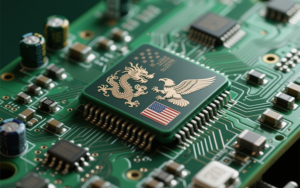
Semiconductors just got a fresh valuation confetti cannon from Bank of America, and the market is doing what it always does when someone says the future is bigger than your spreadsheet: it leans in and pretends not to be scared. BofA’s Vivek Arya now sees the semiconductor industry hitting $3.2 trillion by 2030, with this year’s market around $1.7 trillion, and the sector’s usual suspects are once again being treated like they might actually deserve the attention. The irony, naturally, is that the tape still looks allergic to easy conviction.
That’s the setup: a sector that has already ripped hard, took a gut punch after fresh AI slowdown chatter, and is now being told the long game still matters. The PHLX Semiconductor Index is up about 58% year to date, even after falling more than 5% on Monday before clawing back some ground. So yes, the group is expensive, emotional, and slightly unhinged — which is exactly why investors keep staring at it like it owes them money.
Arya’s call is simple enough for even a caffeine-deprived trader to appreciate. He lifted his wafer-fab equipment view, and said the expansion is being driven by memory-chip and data-center demand, plus a recovery in automotive and industrial demand. He also said there are “no signs of slowing” in customer orders, long-term agreements, supply commitments and chip pricing, and called semis “still screen attractively relative to growth.” In other words: the machines are still buying, the contracts are still signed, and the people who said AI demand was already done may have spoken a little early.
The market, however, never allows a clean narrative. The latest round of nerves followed a selloff tied to Anthropic CEO Dario Amodei’s proposal to slow frontier-model development, which is the kind of headline that makes every GPU cultist reach for the smelling salts. For now, Arya’s message is not that semis are cheap. It’s that they may still have room to grow, even after everyone who owns them has already adopted the vocabulary of a permanent bull.
Micron is one of Arya’s four stocks he flagged as potential leaders once momentum picks up, and that makes sense because memory is where the scarcity story can turn into actual pricing power. Arya said “Memory-chip shortages and price inflation remain a critical lever behind industry growth upside,” which is Wall Street-speak for: when supply gets tight, Micron stops being boring and starts being expensive in a good way. With the broader semiconductor market still expanding, Micron stands to benefit if memory demand keeps doing what the optimists keep promising it will do.
Trading-wise, Micron belongs to the higher-beta end of the semiconductor bucket, which is just a polite way of saying it can move like it drank three espressos and read a macro note. Investors should think of MU as a leverage play on the memory cycle, not a sleepy utility with a chip logo. The key takeaway: if memory pricing keeps firming and AI/data-center demand stays hot, Micron becomes one of the cleaner ways to express that view without buying the whole sector and all its baggage.
Intel also made Arya’s momentum-leaders list, which is interesting because Intel is the stock market’s favorite comeback project: endlessly discussed, occasionally funded, and always one earnings call away from becoming either a genius trade or a case study. The BofA framework matters here because Intel’s role in the semiconductor story is less about glamour and more about whether the company can capture a slice of the industry’s next phase as spending broadens beyond just the AI heroes. That’s not a tiny question when the total addressable market is being nudged up toward $3.2 trillion by 2030.
The trading profile on Intel is the opposite of a clean momentum monster. It’s a debate stock, the kind people buy when they want to believe in industrial redemption and sell when patience runs out. That can make INTC frustrating, but it also keeps the name relevant whenever the market starts asking whether the next leg in semis belongs only to the obvious winners. Takeaway for investors: Intel is still a proof-of-execution story, not a victory lap, and that means every operational checkpoint matters more than the average headline.
Lam Research is one of the more interesting names in Arya’s four-stock setup because wafer-fab equipment is where the sector’s long-cycle spending meets the real economy of chip manufacturing. Arya raised his WFE TAM to $156 billion for 2026 and $210 billion for 2027, with the category reaching about $360 billion by 2030. That matters for Lam because equipment vendors benefit when chipmakers keep opening the taps on capacity, and the call suggests the taps are not exactly being welded shut anytime soon.
On the tape, Lam was under pressure midday, down about 2.21% to $267.44. That’s the semi trade in a nutshell: great long-term setup, short-term mood swing. Equipment stocks often get punished when the market starts obsessing over the next quarter instead of the next upgrade cycle. The takeaway here is straightforward: LRCX is a cleaner way to play the capex machine than many people realize, but it also lives and dies on whether customers keep turning promised demand into actual spend.
4. Applied Materials (AMAT): the other equipment heavyweight, same machine, different sticker price
Applied Materials shares the same strategic lane as Lam Research, and it was also named by Arya as a potential leader once momentum returns. That is not shocking. If the industry’s forecast is rising, the equipment names tend to sit near the front of the parade because they sell the picks and shovels while everyone else argues about the gold rush. Arya’s higher WFE outlook to $156 billion in 2026, $210 billion in 2027, and about $360 billion by 2030 is the kind of backdrop that keeps AMAT in the conversation whenever investors want exposure to semiconductor buildouts rather than just the chips themselves.
But the stock itself was not exactly partying. Applied Materials fell about 1.36% to $418.45 midday, which is a reminder that even names with a good narrative can get tossed around when the whole sector is twitchy. That makes AMAT a classic “buy the cycle, survive the mood” name. Investor takeaway: if you believe the capex run is still alive, Applied Materials remains one of the more direct ways to own it, but it will not spare you from the market’s daily mood disorder.
Nvidia was not one of Arya’s four momentum leaders in this MarketWatch framing, but it remains the name that turns every semiconductor conversation into a referendum on AI. Midday, it was up about 0.41% to $211.83, which is not dramatic, but that’s almost the point. When a stock gets this large and this widely owned, even modest movement still matters because it sets the tone for the rest of the complex. Nvidia is no longer just a chip stock; it is a sentiment gauge for the entire AI trade and half the people with a performance fee.
That also means NVDA is the one investors watch when they want to know whether semis are being bought for fundamentals or simply because nobody wants to be the last person under the tent. The takeaway is blunt: Nvidia remains the benchmark name, but benchmark names can become expectation traps. If the sector’s next leg comes from broader demand, memory, and capex, Nvidia may still lead — yet it no longer gets to own the whole story by default.
Arya’s upgrade is a reminder that semiconductors are still being priced as a long-duration growth story, not a solved problem. The sector may stay “range-bound” near term, as he expects around the U.S. midterm elections and broader macro conditions, but that kind of chop often just sets up the next argument over who deserves the multiple. For investors, the real test is whether the next two quarters of hyperscaler capex guidance and packaging capacity actually turn into shipped units — because in semis, hope is abundant, but wafers still have to leave the factory.