A highly anticipated product debut turned into a stock decline, a federal investigation, and renewed uncertainty over Tesla’s commercial prospects within 24 hours. Tesla (TSLA) held its Cybercab robotaxi unveiling in Austin on Thursday, but the event featured no livestream, no press release, and no appearance by CEO Elon Musk. On Friday, the National Highway Traffic Safety Administration (NHTSA) announced an audit query into Tesla’s self-certification of the vehicle, sending shares sharply lower.
Musk has long been known for spectacle—setting bold goals, making dramatic predictions, and launching a sports car into space. That showmanship has been central to Tesla’s brand. Thursday’s Cybercab event, however, was strikingly subdued. Attendance was by invitation only. There was no live video feed. Tesla’s website carried no official announcement. Musk himself was absent, instead posting pre-recorded videos on X.
Expectations had been high ahead of the event. Tesla shares climbed through Thursday, closing up roughly 7%. But analysts were quick to voice disappointment after the presentation. Wells Fargo analysts described the rollout as “underwhelming” and pointed to “early execution issues” for the Austin robotaxi service. RBC Capital Markets analysts complained of “limited new incremental disclosure,” noting that key questions around pricing, production timing, and regulatory approvals remained unanswered.
The larger blow came from Washington. On Friday morning, NHTSA said it was opening an enforcement action—an audit query—into Tesla’s self-certification of the Cybercab. Federal motor vehicle safety standards require conventional manual controls such as brake pedals, accelerator pedals, steering wheels, and mirrors. The Cybercab has none of these. Tesla had told the agency that it certified the vehicles as compliant with all applicable standards and planned to expand commercial deployment beyond Austin. NHTSA said it would examine the process and technical data behind Tesla’s certification, including whether the company determined certain safety standards were inapplicable to the Cybercab.
The situation echoes the experience of Zoox, Amazon’s self-driving subsidiary. Zoox received its own NHTSA audit query in 2023 after self-certifying a robotaxi for testing. The investigation significantly delayed commercialization, and Zoox did not receive an exemption allowing it to charge passengers until July of this year—more than three years later. Tesla investors have already waited nearly two years since the Cybercab was first unveiled. Many may not be willing to wait another three.
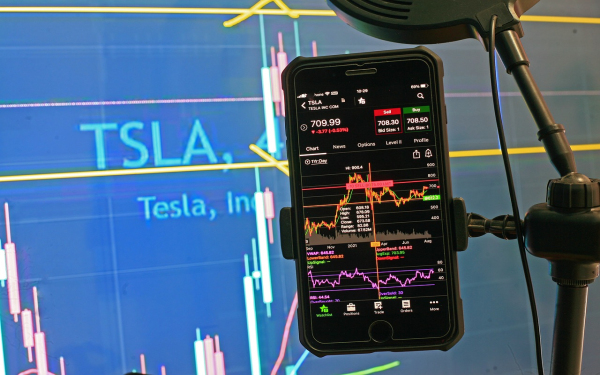
Tesla shares fell 6% on Friday, erasing Thursday’s gains and finishing slightly below Wednesday’s close. The stock is now down 21.4% year to date.
Some analysts remain firmly negative. Wells Fargo’s Colin Langan reiterated a “Sell” rating with a $130 price target, implying roughly 63% downside. GLJ Research’s Gordon Johnson also maintained a “Sell” rating, with a price target of just $24.86. Johnson noted that Tesla provided no rollout target, pricing, or consumer ordering option, and that Musk did not attend the event.
Tesla said Cybercabs would begin operating Friday at 5 p.m. Central time, but only in a limited section of Austin and only during part of the day. Ashok Elluswamy, Tesla’s head of artificial intelligence, said around-the-clock driverless operations may not arrive until next month or so. That stands in sharp contrast to Musk’s social media posts hours before the event, in which he promised “A Storm of Cybercabs.”
Fundamentally, Tesla’s long-term narrative has not changed because of a single event. The company still needs to scale production, secure approval for widespread use of unsupervised Full Self-Driving technology, and deliver on Musk’s decade-long promises around autonomy. But in the near term, regulatory scrutiny, a lack of details, and sharp share-price swings are adding fresh uncertainty. Whether Tesla can once again rely on showmanship to navigate the storm remains an open question.