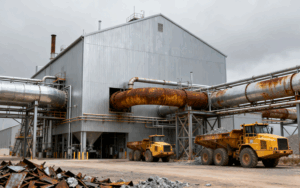
Bannerman Energy’s Etango joint venture has reached final investment decision on its uranium project in Namibia, moving the long-running development from planning into full-scale construction. The decision was announced on 23 October 2026 and applies to the Etango-8 design, which is forecast to produce about 3.5 million pounds of U3O8 a year once operating. For investors, the key point is not just that the project has advanced, but that it has done so with funding already in place, debt-free, and after years of early works and permitting.
The joint venture is held 55% by Bannerman Energy and 45% by CNNC Overseas Limited, or CNOL. The JV holds a 95% interest in the Etango project itself. That structure matters because it shows the project is being advanced through a partnership rather than by Bannerman alone. In practical terms, the FID means the owners have committed to building the project rather than continuing to study it. Bannerman said the decision will lead to full-scale construction activities on site over the coming months, with commissioning and first production targeted for 2028.
Bannerman’s managing director and chief executive, Gavin Chamberlain, described the decision as a milestone for the company, its partner and Namibia. He said, “Today’s FID by the Etango JV is a defining moment for Bannerman, for our partner, CNOL, and for Namibia. It is the culmination of more than two decades of exploration, study and disciplined de-risking, and it formally commits the JV to full-scale construction of the world-class Etango Uranium Project.” The quote reflects the company’s view, but it also highlights a real feature of the asset: Etango has been advanced through a long technical and regulatory process rather than a rushed build.
The biggest near-term positive is funding. Bannerman says forecast pre-production capital expenditure is about US$353 million, plus or minus 10%. Of that amount, about US$64 million had already been incurred through early works to 30 September 2026. The residual pre-production capex is to be funded by existing Etango JV cash of about US$295 million as at 30 September 2026. Bannerman also says its residual working capital share is fully funded by its cash balance of about A$175 million as at the same date, and that construction is debt-free.
For uranium developers, this is an important distinction. Many projects reach FID with a funding gap that still needs project debt, equity dilution or both. Etango appears to have cleared that hurdle for now. That does not eliminate execution risk, but it does reduce financing risk at a time when the project is shifting into a capital-intensive phase. Investors should still remember that capex estimates can move as construction progresses, especially on large greenfield builds, even when early works have gone to plan.
Bannerman said its early works programme has been delivered safely and has tracked to budget and schedule. Chamberlain added that “The bulk earthworks are substantively complete and detailed design is well advanced, with key supporting infrastructure also finished or strongly progressed.” The company’s wording is careful: it does not give a precise completion percentage for earthworks in the release itself, only that the work is substantially complete. That matters because it suggests the project is ready for the next phase, but not yet finished.
This is the kind of progress that de-risks a development project in stages. Site preparation, earthworks, design maturity and infrastructure readiness all reduce the chance of delays once full construction starts. The absence of a detailed build percentage in the primary release also argues for caution. Investors should avoid reading “substantially complete” as equivalent to mechanical completion. The real test now is whether the project can transition from prepared ground to coordinated construction without cost creep or schedule slippage.
Bannerman’s release positions Etango as a significant greenfield uranium project, and the planned output of about 3.5 million pounds of U3O8 a year supports that view. On a simple operational basis, that is enough scale to matter for supply discussions, especially because the project is being built as a new mine rather than a restart. The company also says it has a cornerstone offtake framework on market-based terms, which suggests it has not relied on distorted or highly subsidized pricing to underpin the project.
Still, investors should separate strategic language from hard operating facts. The company is clearly seeking to build a major long-life uranium asset in Namibia, but the evidence pack does not include independent production economics, life-of-mine costs or third-party valuation work. That means the headline production number is useful, but not enough on its own to judge margin quality. The next stages of the project will need to demonstrate that the capital can be translated into reliable output on time and on budget.
Etango’s location in Namibia is one of its main strategic features. The project already has its mining licence, awarded in December 2023, and all environmental approvals have been secured. Those items are often among the most difficult milestones for a large resource project, especially in a jurisdiction where water, environmental management and community engagement can shape project timing. With those approvals in hand, the move to FID suggests the regulatory path is materially de-risked.
That said, approval is not the same as construction success. Namibia provides the jurisdictional platform, but the project still needs to be built, commissioned and brought into steady production. The company’s confidence is helped by the fact that the project has been advanced over many years, with early works already completed. For investors, the jurisdictional story is a positive, but it should be weighed alongside the practical demands of scaling a mine and processing plant in a remote setting.
Bannerman also disclosed a leadership change at the operating level. Danie van Aswegen has been appointed chief executive of Bannerman Mining Resources Namibia, after previously serving as chief operating officer Namibia since October 2025. That is a sensible move when a project is about to enter full construction. It suggests the company wants continuity on the ground and an internal leader who already knows the asset, the team and the local operating environment.
This kind of appointment does not change the project economics by itself, but it can matter during execution. Major mine builds often depend on disciplined project management, contractor coordination and day-to-day decision making. Keeping a familiar executive in place at the Namibian operating company may help maintain momentum as site activity expands. Investors should view it as a support factor rather than a catalyst on its own.
The immediate watchpoints are straightforward. First, Bannerman will need to show that full-scale construction starts on schedule over the coming months. Second, investors will want updates on spending versus the US$353 million capex estimate, especially because early works already accounted for about US$64 million by 30 September 2026. Third, the market will look for evidence that commissioning and first production remain on track for 2028. Those dates matter because development timelines tend to be where optimism and reality diverge.
There is also a valuation question the evidence pack does not answer. No verified share-price move for Bannerman Energy on 23 October 2026 was located in the sources reviewed, so there is no confirmed trading reaction to read into the announcement. That leaves investors to focus on fundamentals rather than price action. On those fundamentals, Etango has taken a genuine step forward: financing is in place, approvals are secured, and the project has moved from de-risking into building. The remaining question is execution, and that is where the next round of updates will matter most.