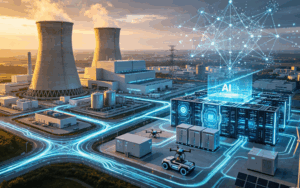

The exact amount of energy consumed by artificial intelligence remains a closely guarded secret. With no laws currently mandating AI companies to disclose their energy usage or environmental impact, most firms opt to keep this controversial data under wraps. Compounding the issue, the constant evolution of large language models, which are growing in both complexity and efficiency, makes it exceedingly difficult for external observers to accurately quantify the sector’s true energy footprint.
While a precise figure is elusive, one thing is certain: AI’s energy consumption is massive and expanding at a rapid pace. Goldman Sachs predicts that by 2030, AI data centers will drive a staggering 165% increase in global electricity demand compared to 2023 levels. Similarly, the International Energy Agency (IEA) forecasts that data center electricity consumption will more than double, reaching 945 terawatt-hours by 2030—roughly equivalent to Japan’s current annual electricity usage.
As AI integrates into nearly everything, from customer service and algorithmic management to warfare systems, its energy demands surge. Despite significant improvements in energy efficiency, these gains are often poured back into developing even larger and more power-hungry models, potentially creating the “energy monster” many fear.
This looming energy crisis has captured the attention of policymakers worldwide. Leaders are urgently assessing AI’s potential impact on energy security, particularly in countries like Ireland, Saudi Arabia, and Malaysia, where planned data center development far outpaces projected energy capacity.
AI is a powerful double-edged sword. While it is undeniably a key enabler for accelerating global decarbonization, AI itself—especially large data centers and model training—is an enormous electricity guzzler. The soaring energy demand may rely on fossil fuels in the short term, creating a direct conflict with emission reduction goals.
Last year, Google admitted that its carbon emissions had skyrocketed by 48% over five years, largely due to AI integration. The tech giant had previously committed to achieving net-zero greenhouse gas emissions by 2030. However, AI-powered services require considerably more computing power—and thus electricity—than standard online activities. As AI becomes more deeply embedded into products, meeting these climate targets poses a significant challenge.
In a rush to address impending energy shortages, both public and private entities across the tech and energy sectors are scrambling to boost production capacity. For Big Tech, the top priority has shifted to securing energy speedily, and in many cases, traditional energy sources offer the fastest solution. Countries are racing to build new power plants and extending the operational life of existing ones, many of which are fossil fuel facilities.
According to data from Global Energy Monitor, more than 85 gas-fired power plants are currently under construction worldwide to meet AI’s energy demand. In the United States, although coal power has been in terminal decline for years, numerous retired plants are now being repurposed—many slated to return to operation as natural gas facilities. While natural gas is cleaner than coal, this shift towards gas may come at the expense of investments in renewable energy projects that could have utilized the same infrastructure and grid connections.