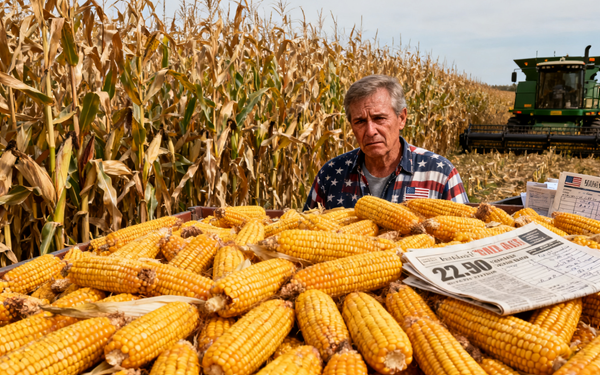
The U.S. Department of Agriculture (USDA) announced in its monthly supply and demand report last Friday that despite a downward revision in yield expectations, American farmers are set to harvest the largest corn acreage since 1933, with total production also exceeding previous estimates. However, the U.S.-China trade war has significantly impacted American agricultural products, particularly the soybean and corn industries.
In detail, the USDA raised its 2025 U.S. corn production estimate to a record 16.814 billion bushels, with an average yield of 186.7 bushels per acre. Although this is lower than the August forecast of 188.8 bushels per acre, it still surpassed analysts’ expectations. Meanwhile, despite a slight cut in the soybean yield projection, total production was revised upward to 4.301 billion bushels due to an expansion in harvested arces.
Following the report’s release, benchmark corn prices on the Chicago Board of Trade (CBOT) came under pressure. Susan Stroud, founder of agricultural analysis firm No Bull Agriculture, noted that although the USDA reduced its corn yield estimate, the substantial expansion in harvested acreage still resulted in a strong overall output. The large harvest is expected to significantly boost grain supplies, benefiting livestock producers and ethanol manufacturers who rely on corn as a key input.
Nevertheless, grain growers continue to face a dual challenge: low crop prices and rising costs for inputs such as fertilizer and seeds. When adjusted for inflation, U.S. crop cash receipts are projected to fall for the third consecutive year, hitting the lowest level since 2007.
Amid the U.S.-China trade war, soybeans have been the most directly affected crop, with China—once the largest export market—slashing purchases to nearly zero. Many orders have shifted to competitors such as Brazil and Argentina. No Bull Agriculture has lowered its U.S. soybean export projection to the lowest level since the trade war during the Trump administration and accordingly raised its ending stocks forecast by 10 million bushels.
The corn industry has not been spared, with export sales to China remaining well below historical averages. Although supply and demand reports occasionally show reduced inventories, ample global supplies coupled with ongoing trade tensions have continued to suppress any sustained rebound in corn prices. In response to the crisis, the U.S. government has provided substantial agricultural subsidies, but these are widely seen as a “band-aid solution” rather than addressing the root cause.
From a long-term perspective, the most profound impact of the trade war has been a permanent shift in global agricultural trade patterns. It is unlikely that U.S. agricultural products, especially soybeans, will regain their market share in China. Brazil, leveraging its competitive advantages, has rapidly captured the market—a structural change that will pose ongoing challenges to the long-term competitiveness of U.S. agriculture.