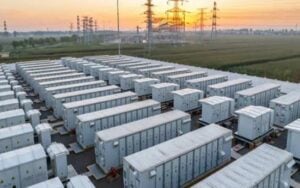
China’s Gotion High-Tech plans a large-scale battery complex in Kenitra, Morocco, billed as Africa’s first battery gigafactory. With an initial 20 GWh phase targeted for late 2026 and a path to 100 GWh, the project is aimed squarely at European demand. The move fits Beijing’s push to seed overseas capacity in new energy industries while Europe struggles to stand up its own supply chain. The bet is big and strategically logical. It is also exposed to trade, financing, and execution risk that will test both Chinese industrial policy and European de-risking.
Gotion’s plan goes beyond cell assembly. The Kenitra site is slated to produce cathode and anode materials inside the park, tightening cost control and reducing exposure to import bottlenecks. Moroccan officials expect most output to ship to the European Union, leveraging Tangier Med port and Morocco’s auto base built around Renault and Stellantis. The capacity ambition is bold. At 100 GWh, Kenitra would rival large European projects on paper. Jobs and local supply chains are central to Rabat’s pitch, with officials touting tens of thousands of direct and indirect positions. The industrial logic is clear: shorten supply lines to Europe, lower logistics costs, and align with EU battery regulations that reward traceability and recycling. Timing also matters. EU policy is locking in a 2035 phase-out of internal combustion sales, and automakers need dependable cell supply now, not in the next decade.
Chinese policymakers have been signaling this shift. Since the 14th Five-Year Plan, Beijing has encouraged high-end manufacturing to go global, pairing capacity cooperation with standards and logistics. Ministries such as MOFCOM and the NDRC have issued guidance backing outbound investment in new energy equipment, while the MIIT’s New Energy Vehicle Industry Development Plan calls for a globally competitive battery ecosystem. State media has framed electric vehicles, lithium batteries, and solar as the new three growth pillars, with an explicit focus on international markets. While Gotion is not a state-owned enterprise, provincial governments like Anhui and the city of Hefei have provided sustained support, and policy banks have funded the broader sector. The result is a cohort of private and mixed-ownership firms exporting production models, process know-how, and vendor networks. Morocco sits within that outward arc, alongside projects in Hungary and North America.
Morocco has done its homework. It offers political stability, investor-friendly zones, and a proven export machine in autos. It holds a free trade agreement with the United States and deep ties with the EU, and it is working to grow renewable power as an input to energy-intensive industry. Tangier Med is a logistics asset. Chinese officials have called Morocco a new hotspot for overseas investment, and Chinese materials suppliers like BTR, CNGR, Hailiang, and Shinzoom are also planting flags. The pitch to Chinese firms is simple: a rules-of-origin friendly platform on Europe’s doorstep, with lower costs than EU production and fewer trade walls than shipping from China. For Morocco, upstream integration into cathode and anode production raises the ceiling on local value-add beyond assembly. It fits Rabat’s industrial upgrade agenda and diversifies away from volatile sectors. The fit with Beijing’s capacity cooperation narrative is tidy.
Europe is short on battery capacity, and several domestic projects have stalled. Volkswagen’s battery arm has been blunt about the gap. We do not have any supply chain. This has to be set up, its executive said this year. Chinese firms are moving to fill it, from CATL in Germany to Gotion in Morocco. The tariff angle is unavoidable. The EU has imposed higher duties on Chinese-made EVs after anti-subsidy probes, and more scrutiny is likely. Producing cells and materials in Morocco does not guarantee tariff immunity, but it helps on logistics and can meet rules-of-origin thresholds that matter for EU market access. That said, European regulators are alert to circumvention. If they judge a Moroccan plant to be a funnel for subsidized Chinese capacity without substantial transformation, more barriers could follow. The policy line will move with politics and the health of local European producers.
Announced capacity is not the same as delivered output. Chinese industry data show a high attrition rate for overseas manufacturing pledges, with a sizable share delayed or canceled as financing, permits, or demand fall short. Morocco offers incentives, but large battery plants need reliable power, water, waste treatment, and skilled labor. They also need input security. LFP chemistry reduces nickel and cobalt exposure but still depends on lithium, phosphate, and graphite. Morocco is rich in phosphates, which helps on cathode precursors, and has a renewable build-out. But lithium and graphite supply chains are global, and Western controls on Chinese battery materials complicate imports. US Inflation Reduction Act rules on foreign entities of concern mean Moroccan-made components tied to Chinese ownership may not qualify for US tax credits even under Morocco’s FTA. That limits the project’s US option set.
The first phase is manageable if anchor customers commit. The 100 GWh end-state needs firm offtake from European automakers. Volkswagen is a logical counterpart, given its stake in Gotion, but the German group is also investing in its own PowerCo venture and must weigh tariff risk, brand politics, and cost. Moroccan authorities will press for a local supplier cluster, and the early arrival of anode, cathode, copper foil, and separator providers would reduce working capital needs and speed ramp-up. Blended finance is likely: Chinese commercial lenders, policy bank support, Moroccan tax holidays and land, and possibly EU de-risking funds if the project can be framed as supportive of European value chains. The difference between a single anchor plant and a durable ecosystem is whether tier-2 and tier-3 suppliers commit in sufficient depth.
If Kenitra delivers, it would mark a step change for African industrial positioning in the energy transition. The continent has long exported raw materials and imported finished goods. A competitive battery park would show that export-grade manufacturing and process integration are possible with the right logistics, power, and policy mix. It would also set a benchmark for how third-country platforms can absorb Chinese manufacturing models and vendor networks. For China, Morocco is a hedge against tariffs and a test of whether exporting capacity and standards can protect market share without inciting sharper barriers. It is also a signal that the sector’s growth is increasingly offshore, consistent with Beijing’s recent emphasis on new quality productive forces and going out 2.0 that pairs technology with localized operations.
Three markers will tell whether this bet sticks. First, binding supply agreements with European carmakers that run beyond pilot volumes. Without them, financing and the ramp to 100 GWh will slip. Second, clarity from Brussels on how Moroccan-made Chinese components are treated under EU battery and trade rules, including any anti-circumvention actions. Policy risk is as material as engineering risk. Third, evidence that the materials cluster is real, not just press releases: BTR and CNGR breaking ground, copper foil lines spinning, and local workforce training tied to specific production milestones. If those pieces fall into place, Morocco will tighten its place in Europe’s EV supply chain at a moment when the EU needs capacity more than ideology. If not, Kenitra risks joining the long list of announced giga-dreams that never leave the slide deck.