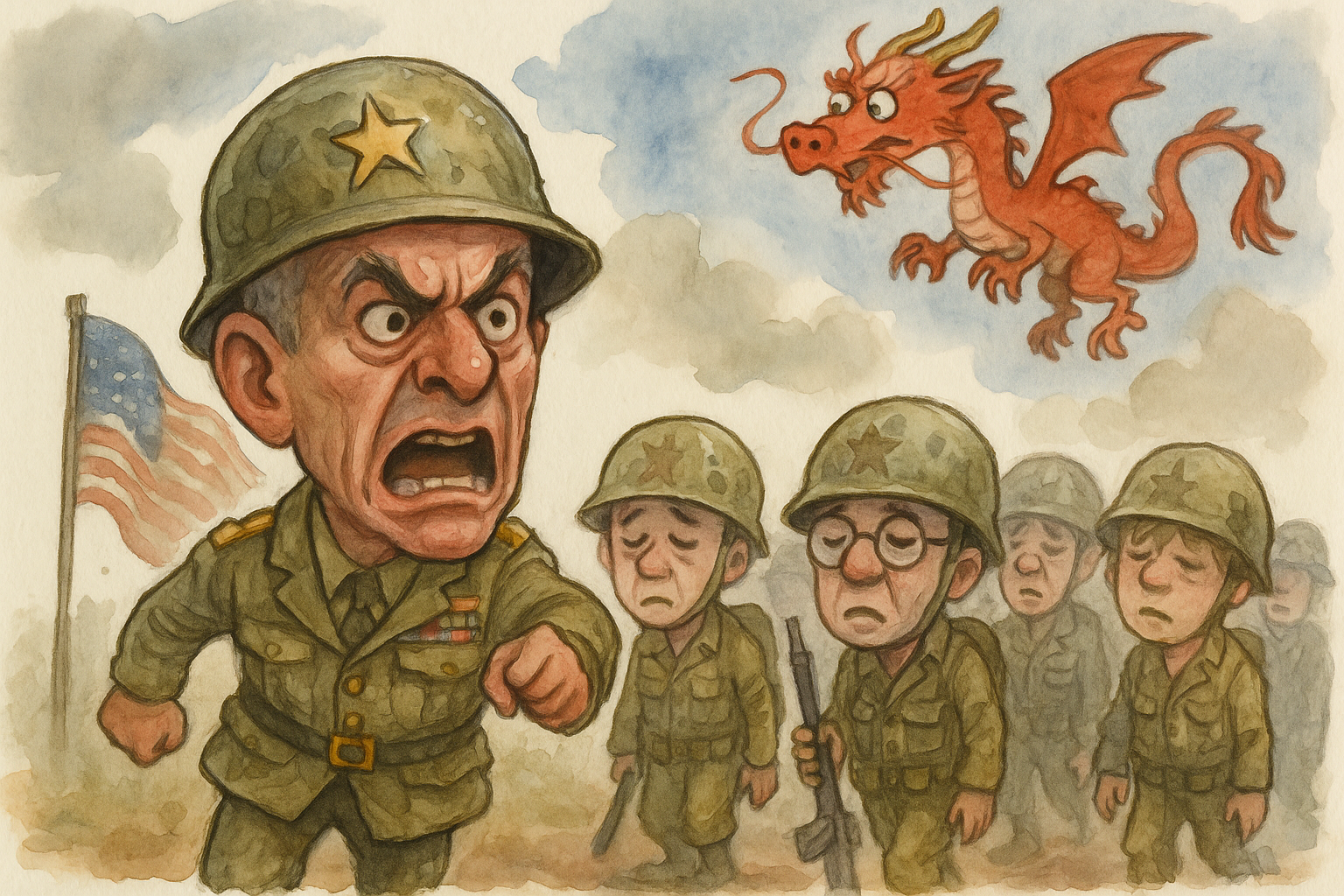
When former Chicago mayor and ambassador to Japan Rahm Emanuel asks if China might finally be the external threat that can unite Americans, he revives an old American habit: finding cohesion through fear. In The Wall Street Journal, Emanuel argues that Americans have spent too long fighting each other and need a common enemy. China, he suggests, may now play the role that Nazi Germany, the Soviet Union, and al-Qaeda once did—a geopolitical “other” to reawaken national unity.
But this is a dangerous misreading of both China’s role and America’s predicament. Because if the solution to America’s disunity is a renewed Cold War, then the country is not recovering—it’s regressing. Worse still, Emanuel offers the kind of cultural nostalgia that imagines America as the passive victim of China’s ambition, rather than the active architect of its own economic decline and political decay.
Emanuel’s central claim is that Xi Jinping’s China is a singular threat: a massive, technologically advanced autocracy poised to replace the U.S. atop the global order. Yet this characterization ignores a basic truth: China has grown not in spite of the West, but in deep integration with it. Its rise is not a hostile inversion of globalization—it’s its inevitable product.
If the U.S. is alarmed by China’s semiconductor ambitions, it must remember that it was U.S. capital markets that underwrote SMIC’s growth, and U.S. tech firms that offshored their entire supply chains to Shenzhen and Suzhou for decades. It was America that, in search of quarterly profits, transferred the manufacturing know-how and capital intensity necessary to scale China’s economy.
Today’s competition is not between two alien systems. It is between a nation that planned and built with long horizons—and one that outsourced everything for short-term gain.
Emanuel invokes the idea of “American exceptionalism” as the guiding light back to national cohesion. But what does this mean in practice?
Is it exceptional to spend $886 billion a year on defense while having 43,000 bridges rated structurally deficient?
Is it exceptional to rank 26th in the world in broadband access?
Is it exceptional that life expectancy in the U.S. is now lower than in China?
These are not signs of a system under siege from abroad. They are symptoms of a system that refuses to look in the mirror.
China is not “racing ahead” in the shadows while America sleeps. It is building while America debates, electrifying while America sues, planning while America tweets.
In the last 10 years:
These numbers are not about authoritarian efficiency—they are about executional capacity. If America wants to win the 21st century, the question is not how to stop China. It is how to relearn how to build.
Emanuel criticizes Trumponomics for imitating China’s state-directed model: public stakes in Intel, golden shares in defense contractors, royalty claims on chip patents. He argues this is un-American. But this misreads the global shift toward sovereign industrial strategy.
The EU, Japan, South Korea, even India—are all deploying industrial policy to secure key sectors: energy, semiconductors, food, AI. America’s allergy to coordinated policy is no longer a virtue; it’s a vulnerability.
China didn’t win by mimicking America. America might survive by selectively mimicking China.
Emanuel longs for the galvanizing unity of WWII or the Cold War. But those eras came with downsides: Japanese internment, McCarthyism, imperial interventions in Southeast Asia and Latin America.
The idea that fear of China will heal America’s social wounds is wishful thinking. Americans aren’t polarized because of a missing enemy. They’re polarized because inequality has hollowed the center, trust in institutions has collapsed, and millions feel dispossessed by a system that no longer delivers.
A unifying mission does exist—but it isn’t containment. It’s climate adaptation, infrastructure revival, technological renewal, fair economic participation, and global cooperation with diverse partners, including China where possible.
If the U.S. truly wants to “prevail in the decades to come,” it must abandon the fantasy of returning to unipolarity. China is not the USSR—isolated, inefficient, ideologically rigid. It is globally enmeshed, scientifically capable, and economically indispensable.
The U.S. must learn how to co-develop the future, not dominate it. That means investing in shared technologies, rules-based standards, open science, and infrastructure interoperability.
There’s a place for rivalry, but there’s also a place for respect. And if America continues to treat every competitor as an existential threat, it may find itself more isolated than exceptional.
Rahm Emanuel is right to say that Americans need a renewed sense of purpose. But he’s wrong to say that China’s shadow is the right path there.
The path to a better American future runs not through confrontation, but through construction. Not through “occupying” domestic adversaries, but through reinvesting in civic trust. Not through romanticizing the Cold War, but by facing the warm reality of a multipolar world.
If China’s rise is a mirror—and not just a threat—then America’s challenge is not to defeat it, but to grow up.