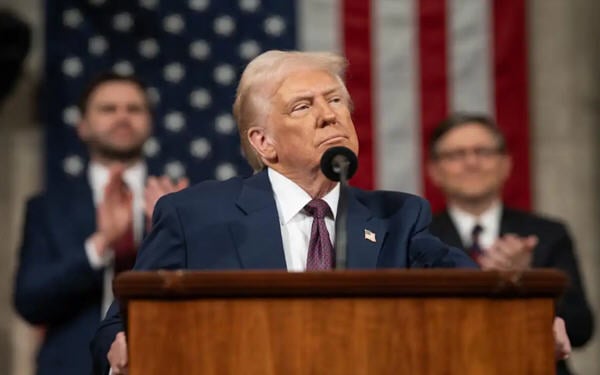
U.S. President Donald Trump publicly lashed out at two oil giants on Monday, accusing ExxonMobil and Chevron of “raking it in” amid supply shortages. Speaking to reporters in the Oval Office, Trump said bluntly: “Chevron is making too much, ExxonMobil is making too much — they ought to give some of that back to the public and they better cut the retail price of gasoline.”
$26.5 Billion in Profits Ignite a Political Firestorm
The immediate trigger for this public pressure campaign was the two companies’ just-released second-quarter earnings. Against the backdrop of the Iran war continuing to push global oil prices higher, ExxonMobil and Chevron combined for approximately $26.5 billion in net income in the second quarter — a “money-printing” performance. ExxonMobil posted net income of $14.5 billion, more than double the $7.1 billion from the same period last year and the highest since 2022. Chevron’s performance was even more striking — net income surged from $2.5 billion in the year-ago quarter to approximately $12 billion, an increase of nearly 400%.
What made the White House even more uneasy was that this windfall did not come from production growth — ExxonMobil’s production was essentially flat, meaning profit growth was entirely driven by rising oil prices. Meanwhile, the average U.S. retail gasoline price has soared from approximately $2.98 per gallon before the war to about $4.10 per gallon, a 40% increase.
The Pricing Logic Is Not That Simple — Refining Capacity Becomes the Key Bottleneck
Trump demanded that oil companies “cut prices now,” but the reality is far more complex than political rhetoric. The core bottleneck for this windfall has shifted from crude supply to the refining segment. Due to the Russia and Middle East conflicts, global refining capacity is severely constrained, and even if crude prices fall, gasoline and diesel prices remain high. Chevron’s second-quarter refining profit surged from $737 million in the year-ago quarter to approximately $4.9 billion, while ExxonMobil’s refining business swung from a $1.3 billion loss in the first quarter to roughly $5.5 billion in profit.
The complex supply chain structure also makes it impossible for any single company to set prices arbitrarily. U.S. domestic oil production, pipeline transportation, refining, and retail involve numerous independently operated enterprises. Any unilateral price adjustment by one company could disrupt the entire supply chain. Trump’s “price cut directive” is more political posturing than actionable command.
The Real Leverage Lies in the Strait of Hormuz
Beyond direct pressure, Trump actually holds a more fundamental lever — quickly ending the Iran war and reopening the Strait of Hormuz.
Trump explicitly mentioned in his remarks that after the war ends, oil prices would “drop through the floor.” Only when the Strait of Hormuz is restored to free passage can global oil supply rebound to levels sufficient to meet demand, allowing oil and gasoline prices to truly fall.
But this is undoubtedly a high-stakes gamble. An energy policy director at Rapidan Energy Group noted that Trump’s timing in pressuring oil companies is driven by midterm election calculations — high energy prices would put the ruling Republican Party in an extremely vulnerable position.
Investors Should Beware the “Political Discount” Risk
For energy stock investors, this standoff between the White House and oil giants signals a subtle shift in valuation logic. Previously, the market priced energy stocks on the favorable logic of “conflict persists → oil prices stay high → profits remain robust.” Now, the higher the profits, the greater the political risk — valuation models need to incorporate a new discount factor.
In the near term, whether oil prices can fall still depends on the fate of the Strait of Hormuz. Until the situation clears, the tug-of-war between oil giants’ high profits and political pressure will remain one of the most critical variables in the energy market.