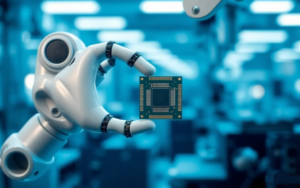
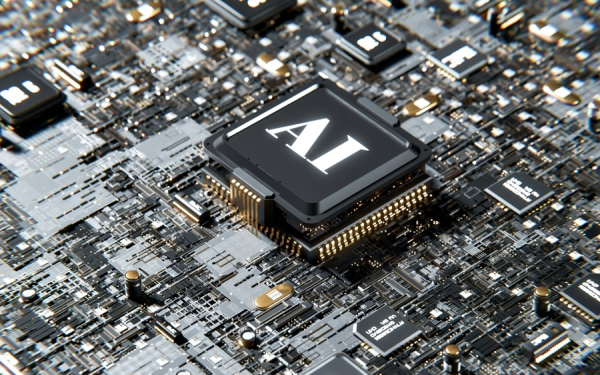
In a move that could reshape the artificial intelligence hardware landscape, Meta Platforms (META) is reportedly in discussions to purchase tensor processing units (TPUs) from Alphabet, sending shockwaves through the tech sector and hitting Nvidia (NVDA) shares during Tuesday’s trading session.
The potential partnership between two of Nvidia’s largest customers signals a significant shift in the AI chip market, with substantial implications for the current industry leader. Nvidia’s stock closed down 4.3% on Tuesday, after falling as much as 7.1% intraday, while Meta shares gained 3.8% following the report from The Information.
According to the report, Meta is preparing to place a multi-billion-dollar order for Alphabet’s TPUs. This development comes as cloud computing giants increasingly seek to diversify their processing infrastructure beyond Nvidia’s graphics processing units (GPUs), which have become the gold standard for training and running advanced AI models.
Meta ranks as one of Nvidia’s top customers, reportedly second only to Microsoft in purchase volume. The social media giant’s heavy reliance on Nvidia’s technology has provided strong incentive to explore alternative processing solutions. While Meta has been developing its own custom chips, the potential turn to Alphabet’s TPUs suggests that the search giant’s technology may currently offer superior performance for certain applications.
Market analysts suggest that if the deal materializes, Meta likely believes Alphabet’s TPUs can deliver more cost-effective performance for specific workloads compared to Nvidia’s high-end processors. This could potentially weaken Nvidia’s extraordinary pricing power in the AI chip market, where the company has commanded premium prices for its industry-leading technology.
The move toward diversifying its AI processing stack appears favorable for Meta’s strategic position. For Nvidia, however, the emergence of viable alternatives from one of its largest customers represents a notable challenge to its growth narrative.
Nvidia’s GPUs have become the default choice for developing and deploying sophisticated AI systems, with their performance advantages enabling record-breaking profit growth and stellar margins. Still, major tech companies have been actively working to reduce their dependence on Nvidia’s technology.
Alphabet, Microsoft, Meta, and Amazon have all invested heavily in developing proprietary processors capable of handling workloads currently dominated by Nvidia. Executives at Google Cloud have reportedly estimated that expanding direct TPU sales to third-party customers could capture roughly 10% of Nvidia’s annual revenue, potentially pressuring the chipmaker’s impressive gross margins.
Nvidia reported a 73.4% gross margin last quarter, down from 74.6% a year earlier but still exceptional for a hardware-focused business. While the development of alternative AI processors by cloud giants was already widely known, Meta’s potential adoption of Alphabet’s TPUs suggests these alternatives may be reaching commercial viability sooner than investors anticipated.
Industry observers note that adoption of Alphabet’s TPUs doesn’t necessarily mean Meta and other customers will abandon Nvidia’s processors entirely. Instead, cloud providers appear to be strategically shifting certain workloads to more cost-effective solutions, whether internally developed or sourced from competitors.
The AI processing market continues to experience robust growth that could potentially support multiple successful players. Nevertheless, the rise of credible alternatives developed by Nvidia’s biggest customers introduces substantial uncertainty to the company’s future growth trajectory, signaling that the AI hardware competition is entering a new, more complex phase.