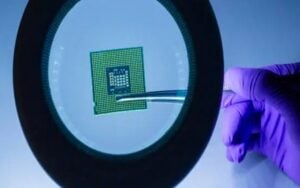
Tesla CEO Elon Musk stated at the annual shareholder meeting in Texas that to achieve its ambitious goals for autonomous vehicles and humanoid robots, the company expects it will need to build a “giant” chip factory. This move would be highly unusual for Tesla, as the global production of advanced chips is currently dominated by a few specialized foundries like TSMC (TSM), Samsung (SSNGY), and Intel (INTC).
Currently, Tesla’s chip supply combines external procurement and in-house design; it purchases chips from companies like NVIDIA (NVDA) and has manufacturing agreements with foundries such as Samsung and TSMC. Musk revealed at the meeting that future collaboration with Intel is possible, and although no formal agreement has been signed, he stated that the discussions are worth advancing. Following this news, Intel’s stock price rose over 2% in after-hours trading. As an established chip manufacturer with its own fabs, Intel has fallen behind NVIDIA in the field of AI chips. Recently, with the US government acquiring a 10% stake, the company is actively seeking external customers for its advanced manufacturing technology.
Musk emphasized that to achieve the projected chip output, he “doesn’t see any other way” apart from building their own production capacity. He proposed building a giant factory with a monthly capacity of at least 100,000 wafers, describing its scale as far surpassing the current “Gigafactories” that produce cars and batteries. Although no specific timeline or location was announced, this plan clearly points towards a strategy for chip self-sufficiency.
Recently, Musk has been deeply involved with Tesla’s chip design team, leading the development of the AI5 chip specifically for internal needs. According to him, this chip performs similarly to NVIDIA’s Blackwell chip but consumes only about one-third of the power and costs less than 10%. He acknowledged the excellent performance of NVIDIA’s chips but pointed out that as a general-purpose supplier, it’s difficult for NVIDIA to optimize extremely for specific scenarios, whereas Tesla’s custom chips can be precisely tailored to its own product requirements.
This chip will be primarily used in Tesla’s two core products: the steering-wheel-less autonomous vehicle Cybercab and the humanoid robot Optimus. Musk announced that the Cybercab will begin production at the Austin plant next April and made several forward-looking predictions about Optimus, including its potential to surpass top human surgeons in surgical procedures, eliminate poverty, expand the economic scale by more than tenfold, and eventually reduce the manufacturing cost to $20,000. These visions collectively outline Tesla’s technology blueprint, with self-developed chips at its core driving force.