
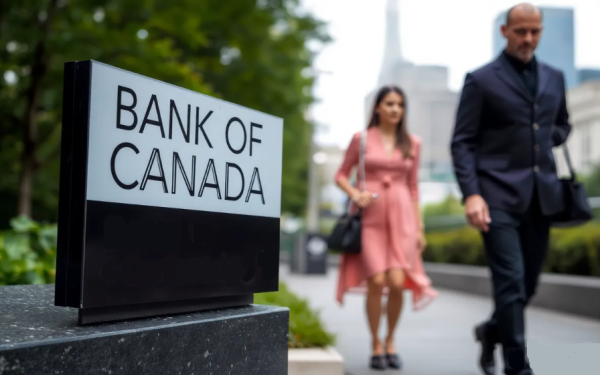
As the Bank of Canada held its key interest rate steady at 2.25% on December 10, attention has swiftly turned to where monetary policy is headed in 2026. Economists from the country’s largest banks—the Big Six—are offering sharply divergent forecasts, highlighting deep uncertainty over inflation risks, trade policy, weak productivity, and slowing population growth.
The predictions form three clear camps: Scotiabank and National Bank of Canada anticipate rate hikes; Bank of Montreal (BMO) stands alone expecting further cuts; while CIBC, Royal Bank of Canada (RBC), and TD Bank project the central bank will hold steady throughout the year.
BMO is the sole voice calling for more easing. Earl Davis, head of fixed income and money markets at BMO Global Asset Management, forecasts the Bank of Canada will cut its overnight rate to 1.75% in 2026, moving into an accommodative stance.
“Frankly, I don’t see any reason for them to raise rates,” Davis said, citing Canada’s significant productivity gap with the United States as a core justification. He warns that a rate hike could strengthen the Canadian dollar, while policymakers likely prefer a weaker currency to act as a “natural balancer” for the economy.
A weaker loonie, Davis argues, attracts international business investment—a dynamic that higher rates would reverse. Short of a major shift in the Canada-United States-Mexico Agreement (CUSMA) or a spike in oil prices, little would alter his call for lower rates.
In contrast to BMO’s dovish stance, Scotiabank and National Bank have turned hawkish, projecting the central bank will raise its policy rate by 50 basis points in the second half of 2026.
Scotiabank’s chief economist, Jean‑François Perrault, points to wage growth, poor productivity, and a depreciating Canadian dollar as sources of inflationary pressure, likely pushing the rate back to 2.75%—the midpoint of the neutral range. Barring significantly weaker growth or inflation, he sees hikes as necessary.
National Bank strategist Ethan Currie’s forecast reflects a notable shift. Previously expecting tightening in 2027, the bank has moved its call forward due to recent resilient economic data. Currie believes short‑term yields will gradually rise if positive momentum continues.
CIBC, RBC, and TD Bank form the largest group, all expecting the central bank to keep rates unchanged next year.
CIBC’s chief economist Avery Shenfeld contends the Bank of Canada “ought to be lowering rates further” but remains sidelined by inflation anxiety. He sees room for cuts given a soft economy and subdued import prices.
RBC’s head of North American FX strategy, Jason Daw, also has a hold as his base case but sees more risk of a hike than a cut. He emphasizes that slower population growth has reduced Canada’s trend growth rate.
TD senior economist Leslie Preston argues prior cuts have done enough to rein in inflation. She expects slow growth to offset cost pressures from trade and supply chains, keeping inflation near the 2% target and allowing the Bank to stay on hold.
Despite differing rate calls, economists uniformly identify uncertainty around the CUSMA trade deal as the most prominent risk. TD’s Preston warns that if the U.S. president “tears up the agreement,” it would pose a severe threat to Canada’s economy. Oil price volatility, a sharp U.S. slowdown, and labour market shocks are also frequently cited concerns.
Bank of Canada Governor Tiff Macklem and his team will have to navigate these conflicting signals and external threats to steer monetary policy in 2026.
The outcome of this three‑way split will ultimately hinge on incoming inflation data, trade policy developments, and the global economic climate. For markets, the only certainty is that uncertainty has become the new normal.