
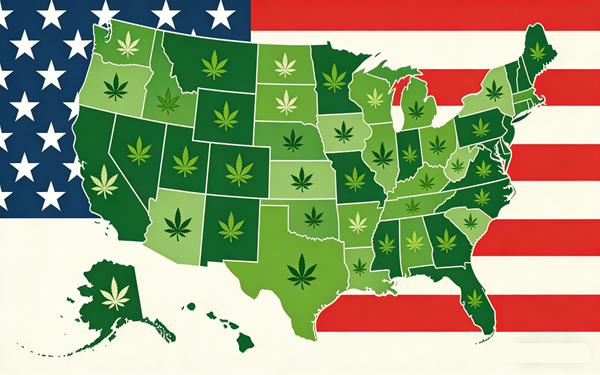
In the United States, cannabis exists in a legal gray zone—a patchwork of conflicting policies that highlights the enduring tension between federal authority and states’ rights. While federally classified as an illegal drug, cannabis has been legalized in some form by a majority of states over the past three decades, reshaping public opinion, economies, and law enforcement priorities.
Cannabis was not always controversial in the U.S. It was widely legal until the early 20th century, when a wave of state-level prohibitions began between 1916 and 1931. The 1937 Marihuana Tax Act effectively banned it nationwide, a policy later embedded in the 1970 Controlled Substances Act, where it remains a Schedule I drug—deemed to have no medical value and a high potential for abuse.
The modern legalization movement took root in 1996, when California voters passed Proposition 215, legalizing medical cannabis. That vote framed cannabis regulation as a matter of state autonomy, setting the stage for ongoing conflict with federal law.
As of 2026, state policies fall into three broad categories:
Even among legal states, regulations vary widely regarding possession limits, home cultivation, commercial licensing, and taxation.
Marijuana Legalization Status in U.S. States & Territories
| Legalization Status | States/Territories | Count |
| Fully Legal (Both Medical & Recreational) |
Alaska, Arizona, California, Colorado, Connecticut, Delaware, Illinois, Maine, Maryland, Massachusetts, Michigan, Minnesota, Missouri, Montana, Nevada, New Jersey, New Mexico, New York, Ohio, Oregon, Rhode Island, Vermont, Virginia, Washington, District of Columbia | 24 states + 1 district |
| Medical Use Only (Recreational Illegal) |
Alabama, Arkansas, Florida, Kentucky, Louisiana, Mississippi, Nebraska, New Hampshire, North Carolina, North Dakota, Oklahoma, Pennsylvania, South Dakota, Utah, West Virginia | 15 states |
Legalization has delivered measurable economic benefits. The regulated cannabis industry has become a significant source of tax revenue and job creation in many states. In health care, studies suggest that medical cannabis laws are associated with lower health insurance premiums and reduced opioid overdose deaths, indicating potential therapeutic benefits.
However, legalization has also brought documented public health concerns. States with recreational markets report increased hospital visits related to cannabis, notably due to accidental ingestion by children. Impaired driving remains a persistent safety issue.
The federal government has recently signaled a historic shift. In May 2024, the DEA proposed reclassifying cannabis from Schedule I to Schedule III—a move that advanced in December 2025 when President Trump signed an executive order directing the Attorney General to begin the rescheduling process.
While not equivalent to federal legalization, Schedule III status would acknowledge cannabis’s accepted medical use and relieve the industry from punitive tax restrictions, potentially unleashing further growth.
Momentum continues at the state level, with public support for legalization steadily rising. Remaining prohibition states face growing internal pressure to reconsider their stance. Congress has yet to pass comprehensive reform, but many analysts believe nationwide legalization—or at least decriminalization—is inevitable in the coming years.
America’s cannabis legalization journey reflects a bottom-up realignment of law, culture, and commerce. It underscores the power of state-led experimentation in the face of federal inertia. With federal rescheduling now underway, the coming years may finally bring coherence to a long-divided national policy. Regardless of one’s stance, cannabis has undeniably become a permanent and transformative feature of the American landscape.