
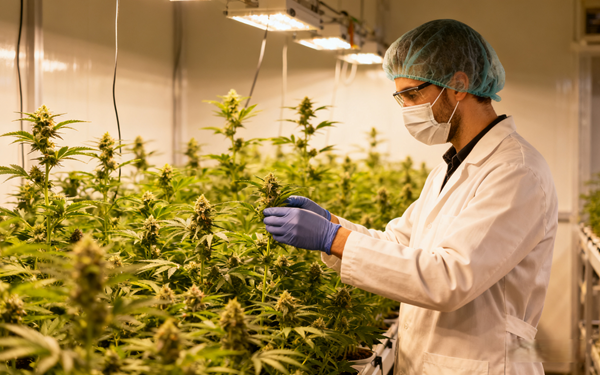
Last week, as SpaceX’s blockbuster IPO dominated global market headlines, the U.S. cannabis sector quietly crossed a long-awaited threshold: Trulieve Cannabis Corp. (TRLV) began trading on the New York Stock Exchange under the ticker TRLV, making it the first U.S.-based marijuana company to list on a major American exchange. The debut ends years of capital market exile for domestic cannabis operators, which were long confined to lightly regulated over-the-counter markets and Canadian bourses due to federal prohibition.
For decades, the core barrier has been federal drug classification. Marijuana’s status as a Schedule I substance — the strictest tier, reserved for highly addictive drugs with no accepted medical use — effectively barred U.S. cannabis firms from the NYSE and Nasdaq. Most traded on OTC markets with far smaller investor pools, where thin liquidity and limited visibility kept pension funds, mutual funds and large institutional managers on the sidelines, denying the sector access to mainstream capital.
That wall began to crumble after U.S. regulators reclassified state-licensed medical marijuana businesses as Schedule III substances, a category for drugs with recognized therapeutic value and lower abuse potential, clearing a critical path for federal regulatory compliance. To qualify for the NYSE, Trulieve restructured its corporate structure: the listed entity holds only its medical marijuana operations, while its recreational cannabis lines remain separate and continue to generate revenue. The setup allows the company to meet exchange rules while preserving full economic exposure to the broader cannabis market.
One of the largest multi-state operators in the country, Trulieve runs more than 200 dispensaries nationwide, with a dominant 170 locations in Florida alone. Its focus on medical cannabis — fueled by growing adoption for pain management and other therapeutic uses — has delivered consistent financial strength. Over the trailing 12 months, the company posted roughly $1.2 billion in revenue, $149 million in operating profit and $224 million in free cash flow, ranking it among the sector’s most financially stable players. Trulieve’s shares have climbed 12% so far this year, giving it a market value of less than $2 billion — still a relatively small footprint even as it leads a burgeoning industry.
The NYSE listing marks more than a single company’s win; it signals a broader shift toward financial normalization for the U.S. cannabis industry. A major exchange listing typically brings higher trading volume, improved liquidity, wider analyst coverage and cheaper access to equity financing for expansion. Most notably, it removes a key compliance barrier for institutional investors, many of whom are prohibited from holding OTC securities. If more operators replicate Trulieve’s structure to secure mainstream listings, the industry’s investor base could expand dramatically.
Projections from Grand View Research put the U.S. cannabis market on track to exceed $76 billion by 2030, growing at an 11.5% compound annual rate — though that trajectory depends heavily on the pace of federal legalization. For years, cannabis investors have waited for tangible proof the sector was moving out of the financial fringes; Trulieve’s debut is widely viewed as the clearest sign to date.
Still, the milestone does not erase the sector’s deep-rooted risks, and the listing alone is no blanket case for buying cannabis stocks indiscriminately.
Many operators still carry heavy debt loads amassed during the industry’s early expansion, when federal restrictions shut them out of traditional banking and forced reliance on high-cost financing to fund acquisitions, cultivation facilities and dispensary rollouts. Rising interest rates in recent years have made servicing that debt far more onerous.
Supply gluts and falling wholesale prices also persist in mature markets including California, Colorado and Michigan, where fierce competition has compressed margins and made profitability increasingly elusive.
Regulatory uncertainty remains the largest overhang. While the Schedule III reclassification is a major policy shift, the industry still operates under a patchwork of conflicting state and federal rules. Cannabis banking reform remains stalled in Congress, interstate commerce is largely prohibited, and future administrations could roll back current regulatory easing. State-level licensing rules, tax policies and market structures also continue to evolve, adding layers of unpredictability for operators.
In sum, Trulieve’s NYSE debut is a watershed moment for U.S. cannabis, proving domestic operators are finally gaining access to the same capital markets available to nearly every other industry. It is not, however, a signal to throw caution to the wind. The long-term growth thesis for the sector remains intact, but its financial, competitive and regulatory risks are as real as ever — and investors would do well to weigh them carefully.