
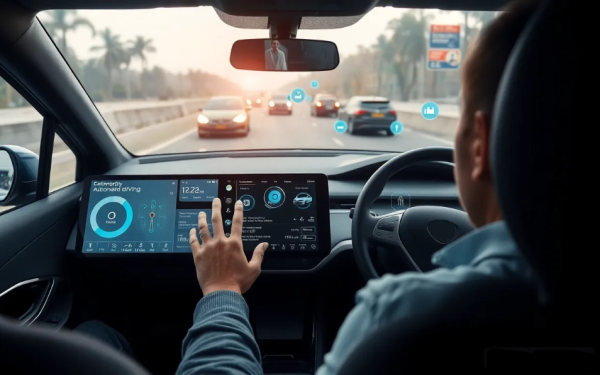
Autonomous vehicle (AV) technology has moved beyond concept into a transformative force reshaping the automotive industry and the broader economy. As the sector matures, a clear value chain—spanning semiconductors, software, vehicle manufacturing, and mobility services—offers investors multiple entry points. In 2026, leadership in technology and commercialization pace will be critical.
Here’s a look at key players across the AV ecosystem.
Nvidia (NVDA) has established itself as the computational foundation of the AV stack, offering end-to-end capabilities from chip design to software. Its DRIVE platform provides everything from cloud-based AI training to advanced autonomous kits for production vehicles—such as those in Mercedes-Benz’s 2024 models. As AV algorithms grow more complex, demand for high-performance computing will continue to drive value in Nvidia’s hardware and ecosystem services.
Tesla (TSLA) pursues a vision-based, vertically integrated strategy, developing its Full Self-Driving (FSD) system, Dojo supercomputer, and closed-loop data pipeline. The launch of its invite-only robotaxi service in Austin in 2025 and subsequent Texas ride-hailing permits mark its expansion into mobility services. The expected debut of a new FSD model and the Cybercab in early 2026 will test both its technical execution and commercial scalability.
General Motors (GM) represents the legacy automaker’s pivot toward autonomy. While its Cruise unit faced operational challenges, GM is now redirecting resources toward advanced driver-assistance and autonomous systems for personal vehicles. Its manufacturing scale and brand network could still play a meaningful role if paired effectively with incremental AV adoption.
Alphabet’s Waymo (GOOGL) is a front-runner in commercial AV services, operating 24/7 driverless ride-hailing across several U.S. cities. With a fleet of over 2,000 vehicles and tens of millions of miles logged since 2019, Waymo has built substantial technical and real-world operational moats. Its business model taps directly into the vast future mobility market, combining technological proof with scalable service delivery.
Alphabet (Google Cloud) and Nvidia also provide critical “digital infrastructure” for the AV industry. Their cloud and software platforms support AI training, simulation, fleet management, and over-the-air updates for automakers and AV developers. As the industry grows, so too will the value of these integrated tools and services.
Each layer of the AV value chain presents distinct opportunities and risks. Semiconductor and cloud enablers offer relatively higher near-term certainty, while vehicle integrators hinge on technological execution and regulatory milestones. Downstream mobility services represent long-term monetization potential but require sustained investment and operational scale.
In 2026, investors may consider aligning selections with their risk tolerance and investment horizon—whether prioritizing foundational tech players, diversified automakers, or pure-play AV service leaders.