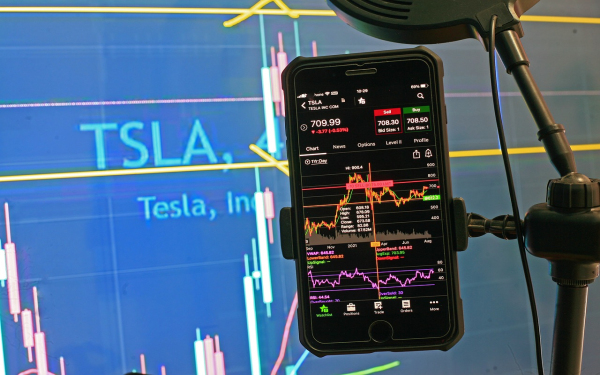
Early 2026 saw Tesla (TSLA) deliver its bleakest annual report since the pandemic. The electric vehicle giant’s net profit plummeted 46% to $3.8 billion, battered by declining sales, the loss of its crown as the world’s top EV maker to a Chinese rival, and fierce competition. Yet, in a perplexing twist, Tesla’s stock price has climbed 9% over the past year even after this dismal financial disclosure.
The market appears to be witnessing a fierce standoff between reality and the future. On one side lies the harsh reality laid bare by the icy financials; on the other, the sci-fi future of robotaxis and humanoid robots that CEO Elon Musk is passionately selling to investors. Where should investors turn?
The numbers themselves are grim. Tesla’s net profit has now experienced steep declines for two consecutive years. Just in the fourth quarter, net income crashed 61% to $840 million. Core automotive operations are under significant pressure: global deliveries for the first three quarters of 2025 fell 9.5% from their 2023 peak, with Q4 deliveries down 15.6% year-over-year.
“They’ve got aging product that is less and less competitive as other manufacturers come out with new models, then there is the general brand destruction,” stated Sam Abuelsamid, an analyst at Telemetry. “Musk’s involvement in politics has turned off customers,” he added, pointing to consumer boycotts following the CEO’s work for former President Donald Trump and his right-wing political stances.
Promised growth levers have also failed to materialize. A year ago, Musk pledged that European regulators would approve Tesla’s partial self-driving software within three months—a move that could have significantly boosted regional sales—but that approval never came.
On the other flank, Musk is working hard to redirect investor focus from car sales to what he calls a “groundbreaking future.” This vision consists of millions of driverless robotaxis and humanoid robots capable of tending to plants and elderly relatives.
This narrative has found a receptive audience among some on Wall Street. Bullish analyst Dan Ives of Wedbush Securities predicts robotaxis will be operating in over 30 cities by year-end and expects Tesla to capture 70% of the global self-driving car market within a decade. Recent developments have added fuel to this story. On January 22, Musk announced on X that Tesla had launched its first robotaxis without human safety monitors inside the vehicles in Austin, Texas.
Concurrently, he announced that Tesla’s Optimus humanoid robots will likely go on sale to the public by the end of 2027. Musk has even claimed Optimus could add $20 trillion to Tesla’s valuation, though he concedes initial production for both robotaxis and the robots will be “agonizingly slow” before scaling up.
Faced with this divide, the investor’s decision boils down to a fundamental question: trust the financial data reflecting the past and present, or trust the future vision Musk is painting?
Tesla is no longer valued as just an automobile company. It is transforming into a complex amalgamation of artificial intelligence, robotics, and future mobility. The stock’s performance already largely incorporates a market “premium” for this CEO’s ability to execute on these long-term visions.
For investors considering a buy in 2026, the question simplifies to this: Do you believe Elon Musk can once again transform seemingly impossible science fiction into tangible commercial success and cash flow? There is no right or wrong answer, but it will determine whether your bet is placed on current financial statements or on faith in an individual and the future he is building. In the Tesla story, the war between data and belief is just entering its most intense chapter.