U.S. Government’s $2.7 Billion Funding for Uranium Enrichment Industry Will Benefit These Companies
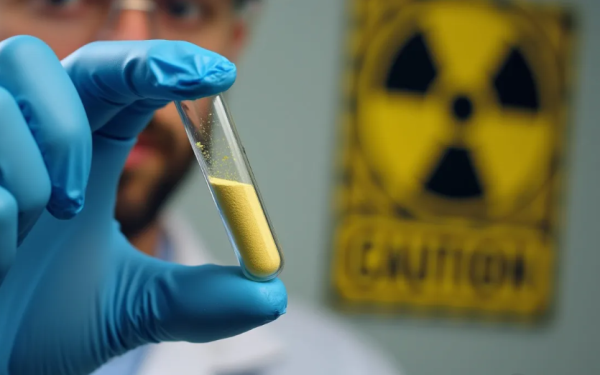
The U.S. Department of Energy (DOE) officially announced that it will provide a total of $2.7 billion in funding over ten years through task orders to three companies, aiming to rebuild domestic uranium enrichment capacity. This investment marks a critical step for the United States in reducing reliance on Russian nuclear fuel and building a self-sufficient, secure nuclear supply chain.
Policy Focus: Achieving Self-Sufficiency in High-End Nuclear Fuel
According to the announcement, American Centrifuge Operating and General Matter will each receive $900 million to establish high-assay low-enriched uranium (HALEU) production capacity. Orano Federal Services will also receive $900 million to expand traditional low-enriched uranium (LEU) capacity. HALEU, an advanced nuclear fuel with a U-235 concentration of 5%-20%, is a core material for next-generation small modular reactors (SMRs), microreactors, and fast reactors. However, currently, almost all commercial-scale production capacity is concentrated within Russia’s Rosatom.
U.S. Secretary of Energy Chris Wright emphasized in a statement: “This funding will ensure the United States can meet the fuel needs of its existing 94 commercial reactors while laying the groundwork for next-generation advanced reactors.” This move directly responds to legislation passed last year, which mandates a complete ban on imports of Russian uranium products by 2028.
Uranium Enrichment Emerges as Key Bottleneck in Nuclear Revival
Despite having the world’s largest operational nuclear power capacity, the U.S. uranium enrichment industry has been in continuous decline since the 1990s, when the “Megatons to Megawatts” program led to an influx of low-cost Russian products. Currently, the U.S. not only lacks commercial-scale HALEU capacity but also suffers from a severe shortage of traditional uranium enrichment capabilities. Industry analysis indicates that the enrichment stage has become the weakest link in the U.S. nuclear fuel supply chain. Russia currently controls approximately 40% of global uranium enrichment capacity, and the U.S. relies on Russia for about 20-25% of its enriched uranium supply.
This dependency has already had a tangible impact on U.S. nuclear deployment. Advanced reactor projects by companies like TerraPower and X-energy have faced delays due to fuel supply issues. The DOE predicts that domestic HALEU demand could reach tens of tons annually by the early 2030s, with rapid growth expected thereafter.
Investment Opportunities Emerge Along the Supply Chain
Policy benefits are expected to generate investment opportunities in three key areas:
Leading Uranium Enrichment Technology Companies: Orano Group, as a French nuclear giant, stands to be one of the primary beneficiaries due to its mature centrifuge technology. Global Laser Enrichment, partly owned by Canada’s Cameco, received an additional $28 million grant for developing next-generation laser uranium enrichment technology, making its innovation capabilities noteworthy.
U.S. Domestic Uranium Miners: Although the current funding focuses on enrichment, domestic uranium mining companies will indirectly benefit from the overall strengthening of the supply chain. Major North American uranium producers like Uranium Energy Corp and Energy Fuels can expect more stable demand projections for raw materials. Companies with projects in the U.S. that can be restarted quickly hold particular strategic value.
Advanced Reactor Developers: Companies like TerraPower (backed by Bill Gates) and X-energy, which have already received DOE funding for advanced reactor demonstration projects, will see their project timelines accelerate due to improved fuel supply security. Many of these companies have power purchase agreements with utilities and tech giants, and alleviating the fuel bottleneck will directly advance their commercialization efforts.
Risks and Outlook
Despite the unprecedented scale of the policy support, building uranium enrichment facilities involves long construction cycles, high capital intensity, and stringent regulatory hurdles. Investors need to monitor the technological maturity of different companies, the achievement of project milestones, and risks associated with international uranium price volatility. Currently, against the backdrop of bipartisan U.S. support for nuclear revival, intertwined with clean energy goals and energy security demands, the localization of the nuclear fuel supply chain has become an irreversible trend. Technology leaders and resource controllers in this field are now positioned at the starting line of a new industry cycle.
Clean Energy
Mining
U.S. stocks
Uranium