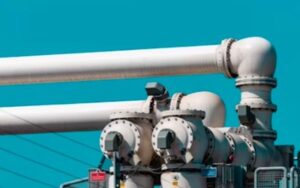
Japan’s megabanks have stepped into India’s power bottleneck. Adani Energy Solutions sealed long-term, green-loan financing led by MUFG and Sumitomo Mitsui for a 950 km high-voltage direct current line moving 6 GW of Rajasthan solar east to Uttar Pradesh. Hitachi, with BHEL as local partner, will supply HVDC equipment. The corridor targets 2029 commissioning and plugs straight into India’s Make in India agenda. Beyond the headline, Asia’s financial press reads this as a deeper strategic shift in Japan-India capital and industrial ties around the grid, not just another renewables deal.
In Tokyo, mainstream financial coverage emphasized the structure more than the sponsor. Local press framed the deal as megabanks exporting decarbonization finance and hardware to a fast-growing, system-critical asset base. The language is telling: terms like 直流送電 HVDC and 長期融資 dominated morning write-ups, alongside グリーンローン under the Equator Principles. Japanese outlets also connected the dots to existing policy. METI’s materials on the bilateral energy framework refer to 日印クリーンエネルギー・パートナーシップの深化, or deepening the Japan-India clean energy partnership, and this deal fits that arc by pairing Japanese balance sheets and technology with Indian grid buildout. In India, Hindi-language coverage and official briefings consistently use हरित ऊर्जा गलियारा for green energy corridor, linking this line to the broader, multi-phase interstate transmission push anchored by the central tariff pool rather than state discoms. That nuance matters for lenders and equity holders because it speaks to cash flow visibility and the lower offtaker risk embedded in national transmission charges versus state utility PPAs.
Equities across Asia digested the news in practical fashion. In India, power and capital goods names opened firm on the signal effect: transmission buildout is now drawing cross-border, long-dated debt at sustainable-finance terms. Adani-linked stocks were volatile as usual, with trade desks flagging early strength in Adani Energy Solutions and selective follow-through in Adani Green before profit-taking set in. State transmission giant Power Grid Corp and EPC adjacencies like cable, transformer, and tower suppliers found buyers on the read-through that HVDC and high-capacity corridors will demand balance-of-system upgrades across the grid. In Tokyo, megabanks were mildly firmer, with traders citing the optics of fee-rich, Basel-friendly project finance in a world of rising domestic loan pricing and still-limited corporate credit demand. Hitachi sentiment improved on the export order narrative, but equipment sentiment is split: HVDC is lumpy, converter stations are capital-intensive, and margin realization depends on localization and execution. Broader indices reflected caution. The Nifty energy complex outperformed defensives, banks were mixed, and utilities traded on fundamentals rather than theme. In Japan, Topix bank and machinery sub-indices edged higher but the move was incremental. The yen backdrop still drives more of bank stock variance than any one overseas mandate. Asian financial outlets kept the tone balanced. As The Japan Times’ business pages have been reporting, Japanese investors want diversification into India’s green buildout, while Bloomberg’s institutional notes underscored the strategic pivot but warned that execution, right-of-way, and regulatory timelines will determine whether this is a template or a one-off. Asia Financial added the policy dimension: alignment is real, but regional tensions and domestic policy shifts can still reshape the path.
The key finance takeaway is not just that Japanese banks are in; it is how they are in. A green loan aligned to the Equator Principles plus HVDC hardware with a Make in India spine suggests a structure that ring-fences project SPVs, leans on regulated returns and the interstate transmission system’s pooled payment mechanism, and embeds environmental and social covenants from day one. For lenders, that mitigates two of India’s classical risks: single offtaker credit and patchy land acquisition practices. For equity, it signals that dividend streams are more grid-tariff than merchant-renewable. Local commentary in Japan hits this explicitly. One Tokyo market note described the rationale as 再生可能エネルギーではなく送電の安定キャッシュフロー, meaning stable cash flows from transmission rather than renewables generation per se. That is how Japan’s megabanks have historically approached cross-border power: regulated network assets over price-exposed plants. Combine that with equipment localization via BHEL and you have less FX leakage and more political buy-in. Importantly, there is no indication that JBIC or NEXI is formally backstopping this tranche; that absence also tells you that commercial banks see sufficient protection in India’s transmission framework. For investors screening Adani’s complex, this is a subtle de-risking signal on the wires business, even as governance headlines continue to shadow group-level multiples.
This corridor will live or die on execution. HVDC is where India’s grid constraints meet physics. Converter stations must be delivered on time, tested against India’s grid idiosyncrasies, and tied into nodes that are already congested in peak season. Right-of-way across 950 km means state-by-state politics, local land approvals, and community engagement that meets both Indian law and lenders’ E&S screens. Indian regulators have accelerated GNA, or general network access, to reduce procedural friction. But that reform now meets a mega-project timeline. Any slippage will show up not only in capex but in the revenue model, which typically starts only once assets are commissioned and tested. Contrarian local analysts have raised feasibility flags, calling the scale too ambitious under current constraints. They also point to bureaucratic inertia that can turn a 48-month stringing plan into a six-year story. These concerns are not idle. India’s grid reform history is a ledger of improved tariff pooling and payment security alongside bottlenecks in state-level coordination. That is why the Japanese choice to finance under a green-loan framework matters: lenders can trigger step-in rights or remedial action if E&S or timeline covenants are breached. For equity, the offset is India’s demand math. If you believe base industrial load and data centers will pull hard on the grid this decade, HVDC that unlocks Rajasthan solar has option value that a spreadsheet cannot fully price.
English-language headlines cast this as another Adani funding line. The regional press makes a bigger point: the bottleneck in India’s energy transition is transmission, and Japan’s banks and OEMs are positioning where the risk-reward is more regulated, more bankable, and more scalable. That suggests three investor angles that are being missed. First, transmission cash flows in India are becoming a quasi-infrastructure bond proxy, especially when linked to the interstate pool. That has implications for the valuation gap between generation-heavy and wires-heavy portfolios. Second, hardware leverage runs deeper than the headline Hitachi kit. Watch Indian-listed suppliers in transformers, HV cables, protection relays, and tower steel. Growth here is not a single project; it is multi-corridor. Third, Japanese financials are not just hunting yield. They are mapping long-dated green assets to their own sustainability targets and duration needs as domestic rates normalize. That reopens the door for more Japan-India project finance in grids, storage, and even ammonia logistics. The risks are clear: land, timelines, and policy drift. But the structure signals that sophisticated lenders think the India transmission story can be underwritten with covenants and regulated returns. If you are only screening generation or headline ESG labels, you will miss where the capital is actually flowing. As one Japanese bank’s sustainability page puts it, サステナブルファイナンスで移行を支援, or support the transition with sustainable finance. Translation for portfolios: the next leg of India’s clean energy trade may be less about new megawatts and more about the electrons’ highway.