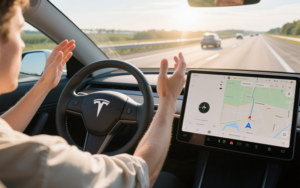

Tesla (TSLA) once again showcased its characteristic grand vision in its fourth-quarter earnings report, but what stood out this time was its attempt to transform beyond its positioning as an electric vehicle manufacturer. The company announced it will cease production of its luxury models, the Model S and Model X, and repurpose a factory into a production base for its Optimus humanoid robots. The revamped factory is expected to have an annual production capacity of 1 million units, with the third-generation Optimus robot, as the first mass-produced version, scheduled for release this quarter. Meanwhile, CEO Elon Musk emphasized progress on autonomous taxis, announcing that models without steering wheels will begin production in April, with plans to deploy autonomous vehicles in “dozens of major cities” by the end of the year. To realize this vision, Tesla plans to invest over $20 billion in capital expenditures this year.
In terms of actual performance, Tesla’s core automotive business is facing challenges. Fourth-quarter vehicle deliveries decreased by 16% year-over-year, marking the third quarterly decline in the past four quarters. Automotive revenue fell by 11% to $17.7 billion, but the number of active Full Self-Driving (FSD) users increased by 38% to 1.1 million, partially offsetting the revenue decline. High-margin regulatory credit revenue decreased by 10% to $401 million. The company’s overall revenue dropped by 3% year-over-year to $24.9 billion, with energy business revenue growing by 25% to $3.8 billion and services revenue increasing by 18% to nearly $3.4 billion. Adjusted earnings per share were $0.50, slightly above market expectations. Notably, the company’s operating cash flow declined by 21% year-over-year to $3.8 billion, while full-year operating cash flow stood at $14.7 billion. Given the substantial capital expenditure plans, Tesla’s free cash flow is likely to turn negative this year.
Recent reports indicate that Tesla CEO Elon Musk is pushing for a merger between his space exploration company, SpaceX, and the artificial intelligence startup xAI to consolidate resources and support expansion in AI and space exploration. The merged entity could be valued at up to $1.25 trillion. xAI currently operates the chatbot Grok but faces significant costs, reportedly burning through approximately $1 billion per month. Merging with SpaceX could provide it with more capital, talent, and computing resources, while advancing the concept of “space AI data centers.” This move further intertwines Musk’s business portfolio and reflects his ambitious plans in future technology sectors.
Tesla’s core automotive business is grappling with dual pressures of declining deliveries and reduced high-margin revenue, prompting the company to shift more focus toward its still-developing autonomous taxi and robotics ventures. However, given Tesla’s history of making grand promises that have not always been fully realized, the market remains cautious about the feasibility of its transformation plans. Investors need to closely monitor the progress of these businesses and the tangible outcomes of capital investments to determine whether these emerging areas can truly become new growth drivers for the company.