
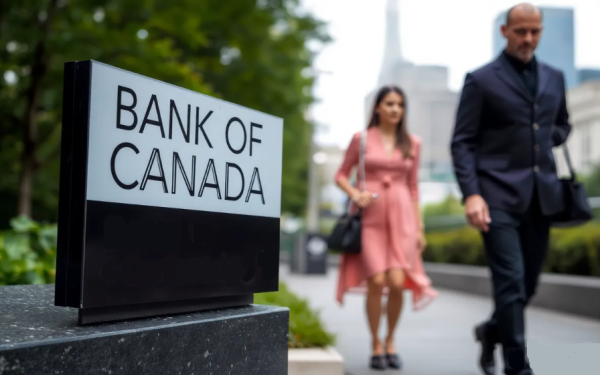
The Bank of Canada held its benchmark interest rate at 2.25 per cent this week, opting for patience amid fresh geopolitical uncertainties. The decision itself came as little surprise—it marks the third consecutive meeting where the central bank has chosen to stand pat. What truly caught the market’s attention, however, was the signal embedded in the announcement: rising oil prices driven by the war in Iran will push inflation higher in the short term, even as the underlying economy proves weaker than expected.
“Canada’s economy is dealing with a lot. And now, we face more volatility,” Governor Tiff Macklem acknowledged during Wednesday’s rate announcement.
That word—”volatility”—has become the defining theme for markets. Data released this week by Statistics Canada showed inflation eased to 1.8 per cent in February, down from 2.3 per cent in January, briefly touching levels close to the central bank’s 2 per cent target. But Macklem offered a clear warning: March’s CPI numbers will tell a different story, as the latest figures have yet to fully reflect the oil price surge following U.S. and Israeli strikes.
The critical question now is whether this inflationary spike will prove temporary or persistent. The Bank of Canada is leaning toward the former. Macklem stressed that policymakers do not believe higher oil prices will trigger a broad-based surge in goods and services costs, giving them room to monitor the broader economy before acting.
“We can’t fix the war,” Macklem said. “What we can do, though, and what we will do, is we will ensure that if energy prices stay high that it does not become ongoing, generalized, persistent inflation.”
In other words, the central bank’s stance is clear: watchful, but not absent.
This posture of patience is creating a unique opening for a specific segment of the market. With the rate hike cycle on pause and borrowing costs no longer climbing, capital is flowing toward assets that offer certainty—particularly high-dividend names with stable cash flows that don’t rely on cheap financing.
Within the Bank of Canada’s policy framework, two types of companies tend to command market premiums: those that can pass inflationary costs through to pricing, and those that generate reliable cash flows regardless of the macroeconomic environment. Canada’s dividend heavyweights often check both boxes.
Take Enbridge (TSX:ENB), the pipeline giant. Roughly 80 per cent of its EBITDA is linked to inflation, meaning that as oil prices rise and costs creep up, so does its revenue. More importantly, the bulk of Enbridge’s income flows from regulated assets and long-term take-or-pay contracts. Whether energy prices soar or slump, the oil and gas moving through its pipelines still need to get where they’re going—and the contract terms ensure payments keep coming. That business model makes it a veritable cash-flow machine.
With the central bank in wait-and-see mode and markets uncertain about the path ahead, Enbridge’s current dividend yield of 5.3 per cent is drawing serious attention. Stable payouts paired with inflation-linked revenue protection position it as a top choice for defensive portfolios.
Another name worth watching is Brookfield Renewable Partners (TSX:BEP.UN). Unlike traditional energy plays, this renewable power giant derives its appeal from the income certainty provided by long-term power purchase agreements. A diversified mix of hydro, wind, solar, and storage assets ensures steady cash flows, while a 5.2 per cent distribution yield is backed by a track record of consistent increases.
What’s more, Brookfield Renewable’s business model also carries built-in inflation protection. Price adjustment mechanisms embedded in long-term contracts help preserve real returns in a rising-cost environment. At a moment when the central bank is balancing inflation concerns against the risk of overtightening, this combination of inflation resilience and stable cash flow looks particularly compelling.
For investors, understanding what the Bank of Canada’s “watchful” stance truly means is critical. Holding rates steady is not the same as doing nothing—if anything, this policy posture offers something markets prize above all else: predictability.
Macklem made clear that the bank stands ready to adjust the policy rate based on the level of support the economy needs. The subtext is that if inflation proves temporary, and if the recovery requires more time, the central bank is willing to be patient. For dividend investors, that patience translates into a more prolonged period of stable rates—and as long as borrowing costs don’t spike, even highly leveraged companies can sustain their payout capabilities.
To be sure, uncertainty remains. The war’s duration, oil’s trajectory, and the actual inflation data yet to come will all shape the central bank’s next move. The April 29 rate decision, paired with the release of the latest Monetary Policy Report, will offer more clarity.
But for now, in this window of central bank patience, the dividend giants built on stable cash flows have every right to call themselves the market’s “comfort pill.” As Macklem put it, the bank can’t fix the war—but it can ensure the inflation it brings doesn’t spiral out of control. And for companies like Enbridge and Brookfield Renewable, as long as inflation stays within bounds, their cash flows and dividends remain the surest anchor of all.