
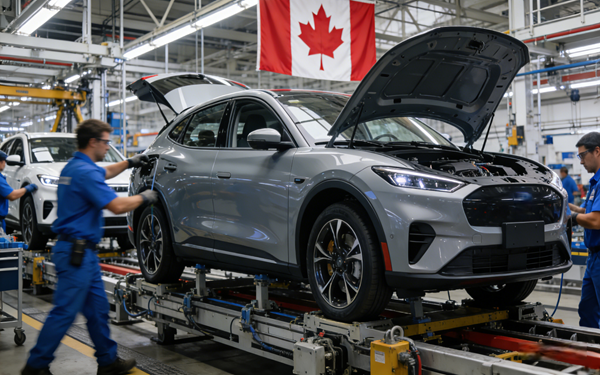
A fierce debate is unfolding around Magna International (NYSE: MGA,TSX: MG), and it perfectly captures the broader uncertainty hanging over the auto supply chain.
Last week, Scotiabank raised its rating on the Canadian parts giant to “sector outperform” and slapped on a $72 price target, betting on a nearly 14% rally from the current price of around $63. Days earlier, Goldman Sachs moved in the opposite direction, slashing its target to $52 and sticking with a “sell” call.
The stock has already tumbled roughly 34% from its highs, and the market is now asking whether this is a bargain entry point or a value trap in plain sight.
The bull case, championed by Scotiabank, leans heavily on Magna’s ability to throw off cash in a hostile environment and its rare insulation from the powertrain wars. Chief Financial Officer Phil Fracassa recently told investors that more than 80% of the company’s portfolio—body structures, seating, mirrors, chassis parts, and advanced driver-assistance systems—is needed regardless of whether a vehicle is powered by gasoline, batteries, or a hybrid setup.
That “powertrain agnostic” profile matters enormously at a moment when automakers are second-guessing their electrification roadmaps. It means Magna doesn’t need to pick a winner in the EV transition to keep its factories running.
The numbers give the bulls plenty to work with. In its most recent quarter, Magna delivered earnings of $2.18 a share, crushing the $1.81 consensus, and revenue of $10.74 billion also came in ahead of expectations. Even in a rough 2025, the company generated $1.9 billion in free cash flow, and management is guiding for $1.6 billion to $1.8 billion this year. That places the stock at roughly 9.8 times forward free cash flow, while the dividend yield sits at a comfortable 3.3%. And that dividend isn’t fragile: Magna has raised it for 16 straight years, and the payout consumes just 30% of free cash flow, leaving ample room for the 22 million share buyback it plans to complete in 2026.
At the operational level, margin improvements are quietly accumulating. The company’s “Factory of the Future” automation push has already delivered about 150 basis points of net margin expansion, with a cumulative 200 basis points expected by the end of 2026. Adjusted EBIT margins are guided higher, and the business carries an A- credit rating from all three major agencies, a rarity among auto suppliers.
Goldman’s bear case, however, zeroes in on everything that can still go wrong. Tariff volatility, potential trade disruptions, and sluggish vehicle production volumes are at the top of the worry list. Even with a powertrain-agnostic product line, Magna cannot escape the reality that its customers are original equipment manufacturers who are themselves cutting costs and delaying programs. Wells Fargo recently cut its own target to $59, underscoring the concern that demand forecasts may still be too optimistic.
Then there’s profitability: despite the operational gains, Magna’s net margin remains a wafer-thin 1.99%. In an environment of elevated raw material and labor costs, a small margin leaves almost no room for error. Goldman’s $52 target essentially argues that the stock has yet to fully price in the convergence of these risks.
The broader analyst community is caught somewhere in the middle. With one “strong buy,” six “buys,” ten “holds” and one “sell,” the consensus sits at “hold” with a $62.40 target—essentially flat from current levels. That collective shrug suggests that, for the moment, the market is waiting to see which side of the trade is proven right.
For investors, the question is whether the 34% haircut compensates for the uncertainty. The bulls see a disciplined compounder with consistent capital returns and a product portfolio built to survive the industry’s upheaval. The bears see a cyclical stock that remains hostage to global trade policy and thin margins. When the Street is this divided, it is often the case that neither camp has the full picture—but the gap between $52 and $72 is wide enough to make Magna a stock that demands attention.