Judging by the latest headlines alone, the electric vehicle giant appears to have bounced back from a painful 30% drawdown. In the first quarter, Tesla (TSLA) delivered 358,023 battery-electric vehicles, outpacing BYD by nearly 50,000 units to reclaim the global BEV crown. Shares ticked higher, and a wave of relief washed over the market.
Yet a closer look reveals a victory that is far less convincing than the headline suggests.
First, that 358,023 figure fell short of analyst expectations of 365,645 deliveries—a classic case of claiming the throne while missing the mark. Second, BYD’s count of 310,389 represents only its pure battery-electric sales. It completely excludes the far more staggering 378,604 plug-in hybrid vehicles the Chinese automaker sold in the same period. While BYD races ahead in total volume with its dual-pronged strategy, Tesla’s recaptured BEV title looks less like dominance and more like a carefully selected statistical footnote.
More troubling signals are emanating from the income statement. As Tesla loses ground in key markets like Europe, its once-legendary pricing power is eroding. Adjusted EBITDA margins have slipped from a peak of nearly 24% in 2022 to below 16% today. When a company’s moat shifts from a technology premium to a price war, the high-growth valuation model that Wall Street relies on begins to systematically unravel.
Meanwhile, just as investors are hoping for a cheaper, higher-margin volume model to stabilize the core business, Elon Musk’s gaze has drifted elsewhere. Rather than confronting the pricing battle head-on, he is doubling down on sub-$30,000 AI-powered humanoid robots, promising commercial production as soon as next year. Given Musk’s well-documented history of overpromising and underdelivering, shareholders have every reason to remain skeptical of that timeline. The same caution applies to the steering-wheel-free, pedal-less Cybercab.
This creates a stark contradiction: How does an automaker with slowing core growth and a distracted CEO justify a market capitalization north of $1 trillion?
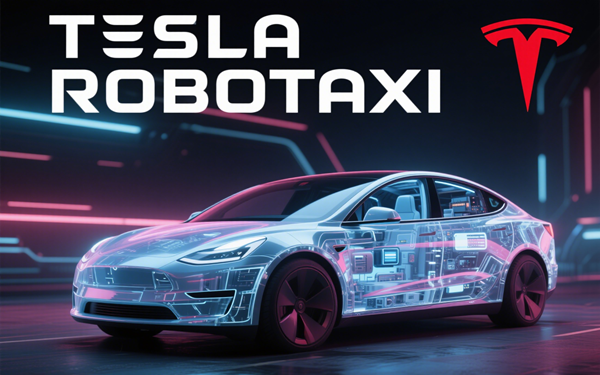
The answer hinges on a single lever: Robotaxis.
This is where Tesla’s true differentiator lies—not in metal-bending, but in its unparalleled access to capital. Even with three consecutive years of declining auto sales, that trillion-dollar valuation allows Tesla to raise billions of dollars in fresh capital at lightning speed, chasing opportunities that smaller rivals cannot even dream of. McKinsey & Co. forecasts that fully autonomous robotaxis will reach global scale by 2030. Wedbush analyst Dan Ives believes autonomy alone could add $1 trillion to Tesla’s market cap, while Ark Invest’s Cathie Wood is even more bullish, envisioning a total addressable market worth $5 trillion to $10 trillion.
To realize this vision, Tesla has gone so far as to discontinue the Model S and Model X, clearing factory space to retool for Cybercab production with an ambitious target of rolling one off the line every ten seconds.
Ultimately, Tesla’s investment thesis has splintered into two parallel narratives. In the tangible present, it is an automaker grappling with share loss and margin compression. In the speculative future, it remains the only company on Earth holding a dual option on the AI and mobility revolutions.
For believers in Musk’s ultimate vision, the near-term noise of quarterly deliveries is just a minor detour on the road to autonomy, and the premium valuation remains justified. But for investors demanding a margin of safety based on current fundamentals, a statistically massaged sales crown is hardly enough to pierce the fog of uncertainty ahead.
This is no longer a race to build electric cars. It is a marathon of faith versus reality.