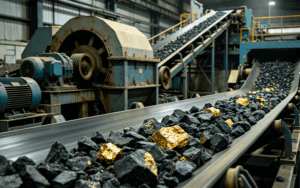
Perseus Mining’s first underground production blast at the CMA Underground below Yaouré marks a practical shift in how the mine will generate ounces over the next several years. Early ore now moving signals the start of a transition from open pit to higher grade underground feed, with steady-state production targeted for the third quarter of the 2027 financial year. It is a milestone that is important because of what it tends to precede: higher mill head grades, a longer mine life, and a more resilient production profile if execution stays on schedule. Elsewhere on the tape, juniors are advancing drill programs, financings, and teams in what remains a selective, catalyst-driven market.
Underground mining typically targets narrower, higher-grade shoot geometry versus an open pit’s broader, lower-grade shell. That trade-off increases unit mining costs per tonne but often lowers cost per ounce because of the grade uplift at the mill. Yaouré’s CMA Underground is designed to tap the high-grade portion of the deposit that was not optimal for open pit extraction, which should improve plant feed quality and reduce reliance on lower-grade stockpiles. That combination can support margins even if power and labor costs trend higher. The first production blast indicates ore development has accessed at least one stoping block. From here, the focus shifts to repeatability: can the team maintain stope cycle times, control dilution, and keep backfill and ventilation in lockstep with the mining rate. If these fundamentals align, the underground should extend Yaouré’s life and stabilize group production.
Côte d’Ivoire is one of West Africa’s more stable jurisdictions with a functioning grid and improving infrastructure, a relative advantage versus neighbors where security has deteriorated. That said, underground mines in the region face similar operating realities. Ventilation and dewatering are energy intensive, and grid reliability can vary seasonally, pushing miners to maintain redundant power. Rainfall patterns influence groundwater inflows; in the wet season, water management can bottleneck development if not sized correctly. Geotechnically, sheared and altered host rocks can be competent at depth but introduce dilution risk if hangingwall or footwall conditions weaken under larger stopes. Paste backfill, ground support quality, and stope sequencing become key controls. None of these risks are new, but they are schedule-sensitive. A few lost months in development can compress ramp-up windows and defer the grade uplift investors are underwriting.
A first production blast is more than ceremonial. It means at least one panel has converted from development to stoping, grade control drilling has defined ore boundaries, and the mill can begin blending underground tonnes. The early stope provides reconciliation data that tests the geologic model under mining conditions. Strong reconciliation supports confidence in the resource, which de-risks future stopes and helps calibrate dilution assumptions used in cost models. It also pressure-tests critical path infrastructure: secondary escapeways, ventilation raises, dewatering, and backfill delivery. If backfill lags, the mine cannot return to adjacent stopes on schedule, and the fill plant becomes the true rate-limiter. Investors should watch for simple markers over the next two to three quarters: stope turnaround times, underground tonnes per day, and commentary on dilution. These drive unit mining costs per tonne and, through head grade, cost per ounce.
Perseus has built a reputation for self-funding growth across a West African portfolio and running with net cash, which lowers dilution risk. The CMA Underground, if it performs, should increase the proportion of higher-margin ounces at Yaouré, supporting group all-in sustaining costs. The near-term trade-off is higher sustaining capital as development advances and backfill plants, ventilation, and dewatering systems reach steady-state. Investors should expect the company to manage a blended feed strategy, using underground ore to lift grade while optimizing open pit and stockpile contribution. The key valuation swing factors are timing to steady-state, realized head grade versus plan, and any step-up in sustaining capital beyond guidance. In a gold price range where small changes in grade drive large changes in margin, even a modest increase in head grade can materially expand free cash flow, but schedule slippage would push that benefit to the right.
Miata Metals reported a long near-surface interval at its Sela Creek project in Suriname, intersecting roughly 100 metres at grades suited to bulk-tonnage open pit concepts. Length and continuity matter here: disseminated mineralization with consistent grade near surface can underpin a low strip ratio, which directly improves economics. The hole sits about a kilometre from the known Jons Trend, suggesting the mineralized footprint is expanding. Early-stage upside is about volume potential and metallurgy. Oxide and transition zones in tropical weathering profiles can offer simple processing if gold is free-milling, but clay content and refractory behavior in fresh rock often complicate recoveries. Geometry is another risk; one long intercept can reflect a favorable drill orientation. Systematic step-outs on orthogonal sections, oriented core, and multi-element geochemistry should clarify the true width and continuity. Infrastructure and permitting in Suriname are workable but field logistics and seasonal access can stretch timelines.
GoldHaven closed an oversubscribed financing to advance high-grade tungsten targets at its Magno project. Tungsten sits on many critical-mineral lists because supply is concentrated and the value chain is exposed to policy risk. That can help capital formation, but it does not remove project risk. Tungsten skarns and veins tend to be high density and high specific value per tonne, yet metallurgy often hinges on gravity and flotation circuits that need rigorous test work to achieve saleable concentrates. Investors should weigh dilution from new equity against the value of incremental drilling and met testing. Intrepid Metals outlined a 2026 program focused on porphyry and carbonate replacement deposits at its Corral Copper project. That is the right tool kit for these systems: district-scale airborne geophysics to map structures and intrusives, 3D zonation models to vector toward hotter cores, and targeted diamond drilling on CRD mantos and chimneys where grades can spike but continuity is the challenge. Success depends on linking high-grade CRD bodies back to a causative intrusion with sufficient scale.
Generation Mining added senior corporate affairs and engineering leadership to advance the Marathon copper and palladium project. Building a mine in Ontario requires deep engagement on permitting, power, and community agreements; assembling that bench now is a precondition to construction. The commodity mix matters. Palladium prices have reset from 2022 highs, while copper’s structural demand story is intact, making project economics more sensitive to copper than before. Project financing and capital cost inflation remain the gating items. First Mining Gold reported year-end cash and recent equity raises that extend runway, but the numbers reinforce the reality of the junior model: incremental capital is needed to advance studies, permits, and drilling. Balance sheets with limited cash need near-term catalysts to avoid value leakage from administrative burn. For investors trying to sift signal from noise, data platforms that aggregate NI 43-101s, resource models, and real-time disclosures can compress diligence cycles. The analysis still rests on fundamentals: grade, geometry, metallurgy, strip or stope economics, jurisdiction, and a credible path to capital.