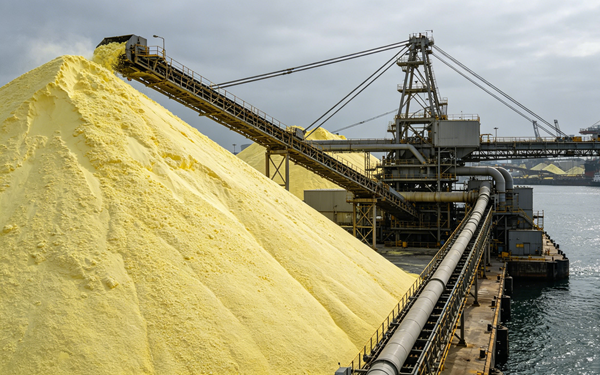
China is preparing to debut its first sulphur futures as early as the fourth quarter of this year, according to people familiar with the matter, with the Dalian Commodity Exchange aiming to list the contract at a time when a perfect storm of supply disruptions and booming new-energy demand has sent prices rocketing to historic highs.
Domestic spot prices of solid sulphur at eastern Chinese ports surged to a record 11,750 yuan per metric ton earlier this month — a leap of more than 210% from levels around 3,800 yuan at the start of 2026. Prices have since eased to about 9,000 yuan as shipments partially resumed through the Strait of Hormuz, but they remain 292% higher than a year ago, a far cry from the 1,000–3,000 yuan range that held for years. The violent swings are hammering costs across fertilizer and new-energy supply chains.
At the heart of the squeeze is a collapse in imports. Sulphur, a by-product of oil and gas refining with almost no standalone production elasticity, relies on the Strait of Hormuz for roughly half of all seaborne volumes. Escalating tensions in the Middle East since late February have paralyzed shipments through the chokepoint, starving China — the world’s largest sulphur consumer — of its dominant supply source. China imports more than half of its sulphur, and the Middle East typically accounts for over 50% of those inflows. In the first five months of this year, imports plummeted by more than 50% year-on-year. A concurrent extension of Russia’s sulphur export ban through June 2026 has further choked alternative channels.
While supply lines falter, demand is being turbocharged from two directions. Phosphate-based fertilizers, essential for grain production, represent rigid, non-discretionary consumption. At the same time, China’s aggressive expansion of lithium-iron-phosphate (LFP) battery capacity has opened a significant new demand stream for sulphur. The widening gap between tight supply and unrelenting demand has laid bare the sector’s vulnerability — limited pricing power, fragile supply chains, and ballooning corporate risk exposures.
The proposed futures contract, therefore, is more than a product launch; it is an overdue risk-management lifeline. Market conditions are ripe: China’s domestic sulphur market is valued at over 30 billion yuan ($4.2 billion), with more than a thousand upstream and downstream enterprises, uniformly specified solid granular product, mature liquid-sulphur storage and logistics networks, and ready delivery infrastructure. Analysts at Huatai Futures noted in a report that the contract would allow industrial users to hedge against severe price volatility, build transparent commercial inventories on the exchange, and — crucially — strengthen China’s influence in global sulphur pricing.
From fertiliser security to new-energy material stability, a vast industrial chain straddling food and energy is urgently awaiting the launch. With cost storms testing corporate survival and geopolitical chokepoints threatening supply lines, the early listing of sulphur futures and options is increasingly viewed not just as a hedging tool, but as a strategic move to reinforce supply-chain resilience.