Electric Metals (USA) Limited (TSXV: EML; OTCQB: EMUS)
Securing America’s Manganese Supply Chain
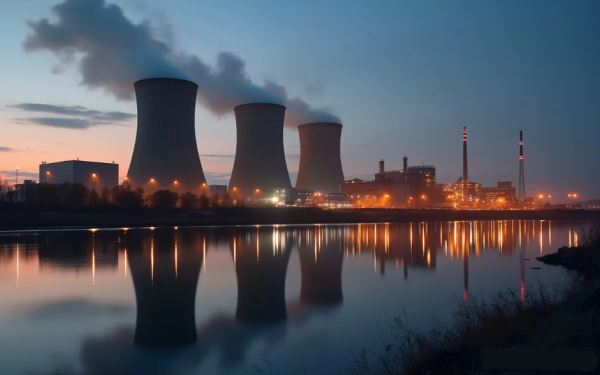
For more than a decade after the Fukushima disaster, the global nuclear energy industry endured a long winter. But as countries push forward with decarbonization goals, and as power-hungry AI data centers and industrial automation drive surging electricity demand, nuclear power is returning to center stage at an unprecedented pace.
The International Energy Agency (IEA) projects that global nuclear capacity will grow by more than 50% from 2025 to 2050. Against this backdrop, three companies – Cameco (CCJ), BWX Technologies (BWXT), and Oklo (OKLO) – represent three distinctly different investment approaches across the nuclear supply chain.
Cameco: The Biggest Beneficiary of the Uranium Price Recovery
As the world’s second-largest uranium producer (behind Kazakhstan’s Kazatomprom), Cameco accounted for roughly 15% of global uranium output in 2025. After the 2011 Fukushima accident, the spot price of uranium plummeted from $62.25 per pound in 2011 to $35.00 in 2020, weighing heavily on the company’s performance. But as of the end of May this year, the uranium price had rebounded to $84.18 per pound. For 2026, Cameco expects its uranium business to produce between 19.5 million and 21.5 million pounds of U₃O₈; its flagship Cigar Lake mine is projected to contribute 17.5 million to 18.0 million pounds. More notably, the company is extending the mine’s life to 2036 through the CLExt expansion project. Its 2023 joint acquisition of Westinghouse Electric with Brookfield Asset Management further extended its reach from mining to the full nuclear fuel cycle.
BWX Technologies: The “Picks and Shovels” Player of the Nuclear Industry
If Cameco is a cyclical bet on uranium prices, BWX is the “infrastructure” play across the entire nuclear value chain. As the only large-scale producer of specialized nuclear components, fuel systems, and naval reactor systems in North America, BWX possesses a nearly unassailable competitive moat – it is the sole supplier of nuclear reactors for the U.S. Navy and holds one of only two NRC Category 1 licenses in the country authorizing commercial processing of high-enriched uranium. Government business accounts for about 71% of its revenue, providing exceptional earnings stability. At the same time, the company is actively expanding into commercial markets such as small modular reactors and medical isotopes, with a record backlog of $7.4 billion in orders. Its 2026 revenue guidance has been raised to over $3.75 billion.
Oklo: The Purest Bet on Microreactors
Unlike the previous two, Oklo is a pure-play concept stock that has yet to generate meaningful revenue. Its Aurora microreactor produces just 1.5 MWe on its own, but can be scaled up to 75 MWe through modular chaining. Using metallic uranium fuel pellets, which are denser, have better thermal resistance, and are cheaper to fabricate than conventional uranium dioxide pellets, the reactor also recycles its fuel in a closed loop, enabling roughly a decade of operation without refueling. In January 2026, the U.S. Department of Energy signed an agreement with Oklo to support multiple reactor projects reaching criticality by July 2026. The company plans to bring its first Powerhouse reactor online at Idaho National Laboratory in 2027. Analysts project its revenue growth to hit a staggering 968% in 2028.
Valuation and Risk: Three Different Approaches
Cameco currently trades at about 53 times next year’s earnings and 17 times sales; BWX at 38 times forward earnings and 4 times sales; while unprofitable Oklo commands a price-to-sales ratio of 211 times its 2028 revenue. All three are richly valued, but their risk-return profiles are vastly different: Cameco is a cyclical amplifier of uranium prices, offering the highest volatility but also the greatest leverage; BWX enjoys the most stable cash flow and the widest moat, making it the more defensive choice within the nuclear theme; Oklo is a pure long-dated option – massive upside if successful, total loss if not.
The long-term thesis for nuclear energy is clear and solid – the exponential expansion of AI computing power, accelerating global electrification, and rising energy security concerns are all continuously fueling the industry. But investors should not forget that this is a sector subject to multiple uncertainties, including policy cycles, technological validation, and geopolitical risks. In this race where nuclear power is being repriced, choosing the right vehicle matters more than simply calling the direction.