
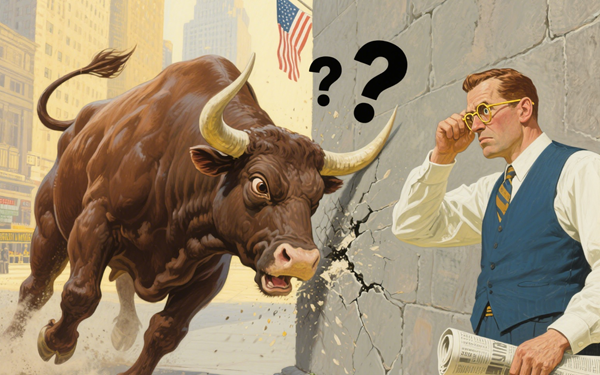
In March 2026, U.S. President Donald Trump authorized military action against Iran, sending geopolitical risks soaring. Brent crude briefly spiked above $130 per barrel, hitting its highest level since March 2022. Investors feared that energy supply disruptions would exacerbate inflation and force the Federal Reserve to raise interest rates. The S&P 500 fell as much as 9% from its March peak.
However, the market’s concerns did not last long. Propelled by strong earnings reports, U.S. stocks quickly shook off geopolitical clouds and launched a historic rebound. By May 29, the S&P 500 had soared more than 19% from its March low in just 41 trading days.
The Historical Pattern Behind the 19% Rally
This gain is statistically extremely rare. Analysts at DataTrek Research noted that the rally has approached a “two-sigma” level, meaning the increase deviated by two standard deviations from the average 100-day return – an event that typically occurs only once or twice every 100 trading days.
According to statistics from Carson Investment Research, since 1950, the S&P 500 has achieved a two-month gain exceeding 19% on only seven occasions. And in every single instance, the signal preceded further upside, with returns that were quite substantial:
| Date S&P 500’s 2-Month Gains Top 19% | S&P 500 Return Over Next 12 Months |
| February 1975 | 29% |
| October 1982 | 32% |
| March 1991 | 8% |
| December 1998 | 19% |
| April 2009 | 36% |
| May 2020 | 46% |
| June 2025 | 23% |
| Average | 28% |
If the index performs in line with the historical average, the S&P 500 – which closed at 7,580 on May 29 – could reach 9,700 one year later, implying roughly 29% upside from its current level of 7,511.
Data from Nasdaq Dorsey Wright also confirms this pattern: since 1957, the S&P 500 has posted rolling two-month returns exceeding 19.49% only nine times, and in those instances, the average returns over the subsequent one-year and two-year periods both exceeded 25%.
Earnings Growth Is the Real Engine
While historical signals are eye-catching, the fundamental driver of the market remains corporate earnings. FactSet data shows that despite high oil prices and geopolitical uncertainty, S&P 500 constituents posted 11.8% year-over-year revenue growth in the first quarter (the fastest since 2022) and earnings growth of 28.8% (the fastest since 2021). Wall Street expects full-year earnings growth of 23%, led by the technology and energy sectors.
Goldman Sachs has raised its year-end S&P 500 target from 7,600 to 8,000, citing that “all of the year-to-date returns have been driven by earnings growth.” As of June 12, the median 12-month price target among index constituents implied 17% upside.
Risks That Cannot Be Ignored
However, beneath the optimistic outlook lie hidden concerns. The May CPI inflation rate spiked to 4.2%, the highest since 2023. If inflation remains elevated, the Federal Reserve may raise interest rates – higher borrowing costs would slow corporate earnings growth, while rising bond yields could divert capital away from stocks.
Deutsche Bank offers a cautionary historical parallel: apart from post-recession rebounds, the only other time since World War II that the S&P 500 rose at such a pace occurred in the months before the 1987 “Black Monday” crash. Prior to the 1987 crash, the S&P 500 had gained roughly 39% year-to-date by the end of August, the Fed was raising rates, and the market was widely concerned about trade and budget deficits.
Market breadth has also been narrowing. Bespoke Investment Group noted that since the March 30 low, the technology sector has surged more than 45%, and the top 13 best-performing stocks in the S&P 500 were all from the tech sector. Ned Davis Research strategists said the proportion of index constituents outperforming the benchmark over the past two months has dropped to the third-lowest level since 1972. This means the rally is largely dependent on a few tech giants, while most stocks have not participated.
Conclusion
The historical signal of the S&P 500 rising more than 19% in two months is indeed encouraging – the historical average suggests nearly 30% potential upside over the next year. However, investors should also be keenly aware that rising inflation, the risk of rate hikes, narrowing market breadth, and the 1987 historical analogue all serve as reminders that this rally may not be a smooth path. Historical patterns provide probabilistic references, not certainties. Maintaining a balance between optimism and prudence may be the most rational stance at this juncture.