
U.S. domestic rare-earth production expanded steadily in 2025, yet the country’s reliance on foreign supplies jumped sharply amid soaring import volumes and shifting Chinese export controls, latest U.S. Geological Survey (USGS) data shows. The updated market dynamics underscore persistent barriers to America’s rare-earth supply chain self-sufficiency.
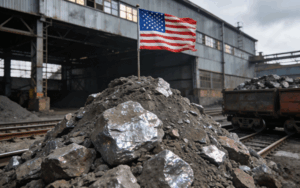
The U.S. scaled up full-cycle rare-earth mining and processing last year, producing 51,000 metric tons of rare-earth oxide (REO) concentrates worth $240 million, up from 45,500 tons in 2024. Domestic operations have formed a clear regional division: Mountain Pass in California mines bastnaesite, southeastern U.S. facilities extract monazite from mineral sands, and Western U.S. plants produce refined rare-earth compounds.
Output of high-value rare-earth compounds and metals doubled year-over-year to 8,900 tons, marking a notable upgrade in downstream capacity. Industry employment also rose from 570 to 670 workers. However, domestic recycling remains immature. Only tiny amounts of rare earths are recovered from batteries, magnets and lighting waste, and heavy rare-earth recycling is nearly non-existent, failing to ease domestic supply shortages.
U.S. rare-earth trade posted a lopsided “volume-up, value-down” trend in 2025. Import volumes of rare-earth compounds and metals surged 169% annually, while total import value dipped slightly from $168 million to $165 million, driven by a greater share of low-cost, low-value imports. Meanwhile, U.S. exports of rare-earth ores and compounds tumbled to 14,000 tons, widening the sector’s trade gap.
Rising domestic consumption pushed America’s net import reliance for rare-earth compounds and metals to 67% in 2025, up from 53% in 2024. Critically, the U.S. is fully dependent on imports for strategic heavy rare earths, with considerable foreign rare-earth content embedded in imported finished goods. End-use demand varies globally: catalysts top U.S. applications, while permanent magnets dominate global demand, alongside batteries, ceramics and metallurgical alloys. Rare-earth prices saw divergent movements, with light rare earths volatile and heavy rare earths mostly steady with modest gains.
U.S. rare-earth import sources remain highly concentrated. Between 2021 and 2024, China supplied 71% of U.S. rare-earth compounds and metals, followed by Malaysia (13%), Japan and Estonia (5% each), with all other regions accounting for 6%. Most third-party supplies rely on Chinese and Australian raw materials. The U.S. imports all its terbium, holmium and lutetium — key heavy rare earths — exclusively from China. The U.S. applies tiered tariffs on rare-earth products, ranging from zero duty on certain oxides and chlorides to 3.7%–5.9% on alloys and carbonates, 5% on rare-earth metals and 5.5% on cerium compounds.
China’s 2025 export policy adjustments reshaped global rare-earth supply fundamentals. In April, Beijing imposed new controls on samarium, gadolinium, terbium, dysprosium and their related products. In October, restrictions were extended to cover all heavy rare earth elements. To stabilize global markets, China suspended the October expansion for one year starting November, while retaining the April rules and issuing general export licenses for eligible domestic exporters.
Facing supply chain concentration risks, the U.S. ramped up industrial support and global diversification efforts in 2025. The U.S. Department of War issued a $150 million loan for a California heavy rare-earth separation facility to strengthen domestic downstream capacity. It also provided an $80 million loan and a $5.1 million grant to advance rare-earth recycling targeting terbium and dysprosium. A U.S. development agency additionally approved a $465 million loan to expand heavy rare-earth output in Brazil. An Australian firm also planned a new heavy rare-earth processing plant in Malaysia, adding new global supply capacity.
Globally, rare-earth mine production totaled 390,000 tons of REO in 2025. China led global output at 270,000 tons, while the U.S. and Australia each produced 29,000 tons. Global rare-earth reserves surpass 75 million tons, led by Australia, China and Brazil. North America holds substantial untapped resources, with 3.6 million tons identified in the U.S. and over 14 million tons in Canada. Analysts note that while rare earths are geologically abundant, commercially viable high-grade deposits are scarce. Available substitutes offer inferior performance, sustaining the long-term strategic importance of rare earths in advanced manufacturing.