
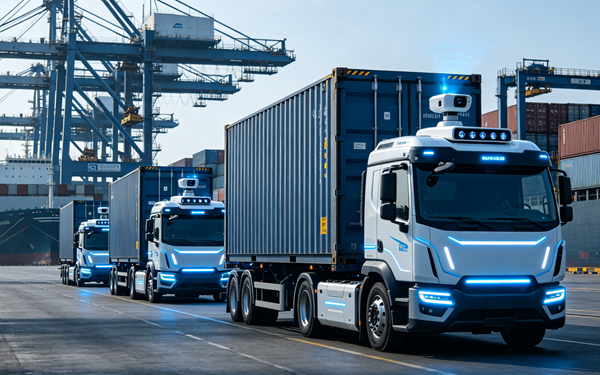
TFI International (TFII), Canada’s largest trucking company, intends to deploy autonomous heavy-duty trucks in the United States next year, with testing set to begin within months. On a conference call, Chief Financial Officer David Saperstein disclosed that TFI is collaborating with a major U.S. autonomous technology provider, aiming to boost reliability, safety and fuel efficiency.
Saperstein emphasized that self-driving trucks can operate day and night without hours-of-service limits, eliminating concerns about driver fatigue, illness or poor driving. “It drives the truck way better. There’s no idling,” he said, noting smoother acceleration and braking that yield additional fuel savings. The unnamed partner has logged millions of autonomous miles across the Southern U.S. with a strong safety record. The autonomous tractors would handle fixed long-haul routes between terminals and distribution centers, and Saperstein pointed out they also remove the headache of driver turnover and absenteeism.
While autonomous big-rigs are already on U.S. roads — Aurora Innovation hauls food and dairy in Texas, and Kodiak Robotics moves frac sand in Texas and New Mexico — Canada has moved more slowly. Startup Waabi operated over a dozen driverless trucks for Uber Freight between Dallas and Houston last year, but regulatory hurdles have delayed deployment at home. Gatik plans to roll out 50 autonomous box trucks across Loblaw’s Greater Toronto Area network by year-end, some already delivering groceries without a safety driver. Despite skeptics’ concerns about complex traffic and bad weather, TFI executives voiced little hesitation. “This has moved a lot faster than we thought. It’s very, very exciting,” Saperstein said.
The autonomous push comes as TFI’s fundamentals strengthen. Second-quarter net income jumped 39% year-over-year to US$136.2 million, while revenue rose 12% to US$2.29 billion. Higher freight rates, combined with Canada’s crackdown on “Driver Inc.” misclassification and U.S. enforcement against unsafe drivers, lifted margins across all three business segments. CEO Alain Bédard noted the Driver Inc. issue is “starting to become less.” TFI subsequently raised its third-quarter adjusted earnings guidance to US$1.70–US$1.80 per share, exceeding the consensus estimate of roughly US$1.66. Bédard added that tariffs have pressured steel and forest product shipments, but aluminum is unaffected, with Quebec volumes “flying out the door.”
Longer term, TFI’s track record is compelling. Over the past decade, its dividend has grown at a compound annual rate of 14%, rising 258% cumulatively, while the stock has surged 770%; the current yield stands at just 1.2%. With the freight environment improving, the drag from illegal labor practices fading, and the autonomous-driving narrative adding fresh upside, the question is whether driverless trucks can become a new investment catalyst. The pace of change is accelerating, and much will depend on how quickly the technology is deployed.