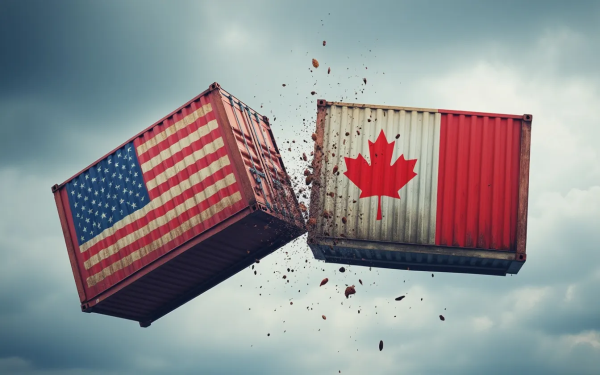
The Trump administration has imposed 50% tariffs on roughly $20 billion of Canadian goods after last-minute trade negotiations collapsed. Prime Minister Mark Carney has pledged dollar-for-dollar retaliation starting September 8, targeting U.S. steel, dairy, electronics, appliances, and agricultural equipment. As trade tensions intensify across North America, Canadian companies with heavy cross-border exposure are coming under direct pressure. Canadian National Railway (TSX:CNR), Magna International (TSX:MG), and Algoma Steel Group (TSX:ASTL) stand out as the most exposed names.
Washington and Ottawa appeared close to a deal only days earlier. According to Reuters, negotiators had discussed lowering the U.S. tariff on Canadian-built autos from 25% to 15% and cutting steel and aluminum tariffs by roughly half. Instead, the talks fell apart. U.S. Trade Representative Jamieson Greer said Canada had upended the careful balance reached during negotiations, while Prime Minister Carney called the final U.S. demands unfair and uneconomic.
The new 50% tariffs cover plywood, liquor, electrical equipment, furniture, food products, hockey equipment, and other consumer and industrial goods, affecting about 5% of Canada’s exports to the United States. Ottawa is not letting the matter slide. Carney has committed to dollar-for-dollar retaliation beginning September 8, with a target list that includes U.S. steel, dairy, electronics, appliances, agricultural equipment, and alcohol.
Trade wars rarely produce perfectly symmetrical responses. Canada does not need to impose 50% tariffs on the same products Washington targeted. It can select American industries where Canadian buyers have alternatives and U.S. producers have more to lose. Steel, dairy, electronics, appliances, agricultural equipment, and alcohol have therefore landed in the crosshairs.
Inflation pressure also deserves attention. A fresh round of tariffs can raise input costs while consumers and businesses are still absorbing higher prices. Still, investors should keep the scale in perspective. The newly targeted Canadian goods represent roughly $20 billion in trade, compared with $383 billion of Canadian goods imported into the United States in 2025. The current tariff package remains a localized shock. The greater danger lies in escalation across the approximately $2 trillion North American trade relationship.
Canadian National Railway does not pay tariffs on the goods it transports, but the railway is tightly linked to the flow of goods across the continent. Weaker manufacturing activity or slower cross-border trade could reduce freight volumes. Canadian National is one of the larger and more diversified railways in North America, with exposure to multiple commodities and industries. Yet its central role in Canada-U.S. trade makes it a textbook example of how tariff pressure spreads beyond directly affected companies.
Magna International is one of the world’s largest auto parts suppliers and operates within a highly integrated North American auto industry. Parts and finished vehicles frequently cross borders multiple times during the manufacturing process. Before this latest escalation, Magna was already dealing with softer North American vehicle production. A prolonged trade dispute adds further uncertainty around production volumes, costs, and customer demand.
Algoma Steel Group faces a more direct hit. The company has already been contending with 50% U.S. tariffs on Canadian steel. Algoma Steel Group recently noted that the duties have effectively closed off its traditional U.S. market, forcing it to redirect more production toward Canadian customers. In the latest quarter, U.S. shipments accounted for only 23% of total steel shipments, down from 54% in the prior-year period. That shift is one of the clearest examples of tariffs directly reshaping a company’s operations.
The latest escalation does not necessarily mean investors should sell every Canadian company with U.S. exposure. Instead, it highlights the importance of diversification. Trade disputes can create short-term volatility, but they can also open opportunities elsewhere. Companies with a diversified customer base, strong pricing power, and the ability to redirect products to other markets are better positioned to absorb the disruption. By contrast, firms heavily dependent on U.S. customers or cross-border supply chains face greater pressure.
For now, Canadian investors should monitor negotiations closely and track how Canadian National Railway, Magna International, and Algoma Steel Group are adapting. The escalation in the North American trade war does not change the long-term fundamentals of these businesses. It simply adds another risk that requires ongoing attention.