
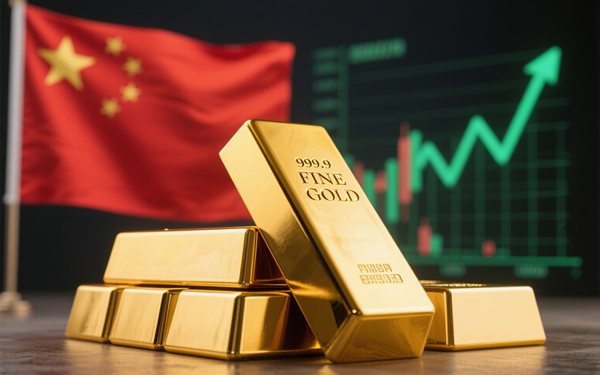
In 2025, nine of China’s top government agencies jointly issued the Gold Industry High-Quality Development Action Plan for 2025–2027, formally designating gold as a “strategic mineral” and a “cornerstone of financial and industrial security.” The move marks a decisive shift in official policy: gold is no longer treated merely as a financial asset but as a pillar of national security. S&P Global sees this as a clear signal that Beijing will keep expanding official holdings, deepen support for the domestic gold industry, and encourage Chinese miners to outpace their global counterparts — all while consolidating China’s standing as the world’s largest producer and consumer of gold.
The elevation did not come out of nowhere. Over the past two decades, Chinese gold policy has progressed from market liberalization to global integration. The privatization of the gold market in 2004 ended more than fifty years of strict state control, followed by measures that encouraged private gold ownership, opened banking channels for bullion investment, and strengthened exchange infrastructure. The results were striking: China overtook South Africa as the largest gold producer in 2007 and surpassed India as the largest consumer in 2013. The new strategic framing arrives at a moment when, in the words of China’s leader during an April 2026 meeting with the Spanish prime minister, “the international order is crumbling into disarray.” Tariff wars, geopolitical confrontation, and sanctions risk have all reinforced gold’s weight in policymaking.
Beijing’s engagement with gold is far more comprehensive and durable than a simple buying spree. The core motivations are long-term: raising economic resilience, reducing external dependence, and broadening the global use of the renminbi. These objectives imply gradual progress and sustained commitment rather than abrupt moves. In practice, the strategy spans multiple tracks — periodic accumulation of official reserves, construction of a yuan-denominated gold trading system, and support for gold exploration and production both at home and abroad.
On the reserve front, the People’s Bank of China resumed gold purchases in late 2022. In the first half of 2026, holdings rose by more than 40 tonnes, more than double the 19 tonnes added in the same period of 2025. Yet gold still accounts for only 6.7% of China’s total official reserves, well below the developed-market median of 16.6% and also below levels in Africa and emerging Asia-Pacific. By value, China’s official gold holdings stood at roughly $324 billion at the end of 2025 — sixth globally, less than one-third of the United States’ total, and behind Germany, Italy, France, and Russia. That mismatch between being the largest producer and consumer and holding only a mid-sized reserve has drawn attention in policy and industry circles. A senior executive at Shandong Gold recently noted publicly that China’s reserve ranking does not match its industrial position. Such “catch-up” sentiment is likely to support continued accumulation.
The corporate side tells a similar story of acceleration. Leading Chinese miners such as Zijin Mining and Shandong Gold have stepped up acquisitions both domestically and abroad, with deal sizes jumping from hundreds of millions to billions of dollars. Their footprint now spans Southeast Asia, Central Asia, Latin America, and Africa. In 2025, China’s domestic gold output edged up just 1% to 381 tonnes, while overseas production by top Chinese miners surged 25% to 90 tonnes. That stands in sharp contrast to global production, which has stagnated despite record prices, held back by mine development timelines that now average 17.5 years from discovery to production, elevated capital costs, and memories of the last downturn. Chinese miners, backed by better execution, solid balance sheets, and ample financing, have expanded without materially weakening their credit profiles.
Perhaps the most strategically telling initiative is the “Gold Road.” In 2025, China opened its first offshore gold vault at Hong Kong’s airport, with an initial capacity of 150 tonnes. Certified by the Shanghai Gold Exchange and operated by Bank of China (Hong Kong), the facility supports yuan-denominated gold trading and conversion outside the US dollar system. Hong Kong plans to expand storage capacity tenfold to more than 2,000 tonnes within three years, positioning itself as a regional bullion hub. Similar vaults could eventually appear in Singapore, Dubai, Riyadh, Moscow, and other locations, forming a global network that links renminbi internationalization to physical gold. For countries in the Global South, such infrastructure offers an alternative for reserve diversification and reduced reliance on dollar clearing.
Taken together, the pieces form a coherent whole. The market reforms of the 2000s solved problems of supply and investment access. The globalization push of the 2010s advanced cross-border use of the yuan. Today’s “strategic mineral” designation embeds gold squarely within the framework of national security. This is not a play for short-term price gains but a long-term structural repositioning. As geopolitical tensions persist, China’s role in global gold markets is likely to keep expanding. Gold is moving beyond its traditional identity as a commodity and reserve asset — it is becoming a key piece in a much larger strategic game.