
Kirkland Lake Discoveries Corp (TSXV:KLDC, OTC:KLKLF)
District-Scale Exploration in World-Famous Gold Camp
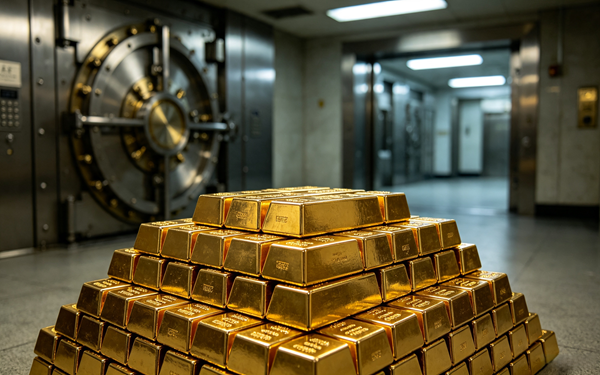
Central banks kept up their robust gold purchases in August, with China, Poland and Uzbekistan leading the way — while some nations also rearranged vault locations as reserve managers reposition for a more fragmented world.
Net official-sector gold purchases totaled 39 metric tons last month, the World Gold Council said, bringing the year-to-date total to 170 tons.
The People’s Bank of China added 20 tons, extending its buying streak to a 22nd straight month. Its official gold reserves now stand at about 2,387 tons, or 9% of total reserves, with year-to-date additions reaching 80 tons.
Poland’s central bank bought 8 tons in August, lifting its 2026 purchases to 98 tons — the most of any nation — and total reserves to 648 tons, putting its 700-ton target within reach. The Bank of Uzbekistan also bought 8 tons, bringing its year-to-date haul to nearly 50 tons; gold now makes up 90% of its reserves.
Kazakhstan added 7 tons, the Czech Republic 2 tons and Turkey 3 tons, resuming purchases after three straight months of net sales. Bolivia and Ghana each bought about a ton. On the selling side, Russia’s central bank sold 6 tons in August — 56 tons year-to-date — while Jordan sold 3 tons.
Some reserve managers also rearranged where their gold sits. De Nederlandsche Bank said Sept. 2 it was moving 86 tons from New York and Ottawa to London to improve the liquidity and tradability of its holdings, following a similar operation by the Bank of France in 2025.
The buying is being driven less by inflation hedging and more by strategic reserve goals, according to a UBS Asset Management survey. About 65% of central bank respondents cited diversification as their primary reason for holding gold in 2026, followed by geopolitical risk management. Gold was also among the assets reserve managers expect to add over the next 12 months, alongside euro- and yuan-denominated assets.
“This is about creating a more diversified reserve structure,” said Tomasz Malkowski, chief dealer for FX and gold at Poland’s central bank. He said the purchases are not intended to replace euro or dollar holdings, and that geopolitical uncertainty has become the top concern among reserve managers since Russia’s invasion of Ukraine in 2022.
A key draw, officials say, is gold’s unique status as an asset that is no one else’s liability.
“It’s something physical that you can store in your vaults,” said Gioia Cellai, deputy director general for markets and monetary policy operations at the Bank of Italy. That trait has grown more important after Russia’s foreign reserves were frozen, she said, making bullion held domestically seem less exposed to sanctions.
Italy holds about 2,450 tons of gold. In 1974, it pledged 500 tons to Germany’s Bundesbank in exchange for a $2 billion loan. Gold now makes up about 30% of the central bank’s assets.
For Ghana, gold has become a tool to convert mineral wealth into reserves and macroeconomic stability. The central bank began buying domestically mined gold with local currency in June 2021, purchasing 3.47 tons in 2022, 37 tons in 2023, 56 tons in 2024 and 110 tons in 2025. It has since agreed to buy 30% of large miners’ output — about 30 tons a year. Inflation in Ghana fell to 5.4% in 2025 from about 24% the previous year, said Gershon Agbledzorwu, head of financial markets at the Bank of Ghana.
Massimiliano Castelli, head of strategy for sovereign institutions at UBS, described the broader shift as “dissatisfaction without displacement” — central banks are not dumping Treasuries en masse, but are marginally adding gold around their traditional reserve holdings.
Almost 90% of respondents at the London Bullion Market Association’s annual conference expect central bank gold purchases to either accelerate or hold near current levels over the next five years.