The 10-year Treasury yield hit a 2002 high Thursday as the author of “Currency Wars” argues Washington will shrink its $40 trillion debt through inflation, not repayment — and that bullion has already shown savers where to hide.
The US government owes more than $40 trillion and spends roughly $1 trillion a year just servicing it. Jim Rickards, author of “Currency Wars,” doesn’t expect Washington to ever pay that back. Inflation, not repayment, is how the debt gets handled, he argues — and gold has already shown savers where to hide.
Spot gold traded near $4,159.11 an ounce Thursday, up 0.10%, while silver rose 0.18% to $60.980. Bullion remains roughly 7.6% above the $3,866 it fetched a year ago, though still below the record $5,589.38 touched on Jan. 28.
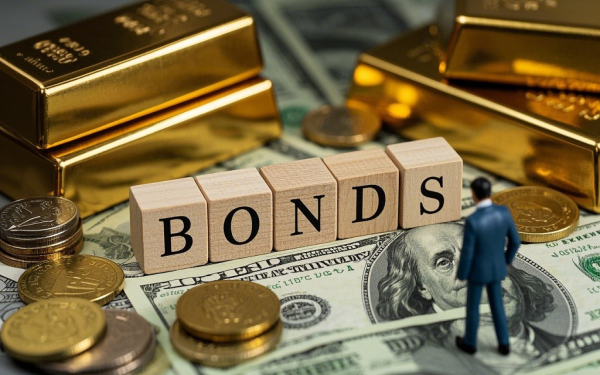
Rickards’ starting point is blunt: the US doesn’t need to repay its debt, only roll it over at a reasonable rate. That is getting harder by the day. The 10-year Treasury yield touched 5.34% Thursday, the highest since 2002. Britain’s 30-year yield climbed above 6% for the first time since 1998, and a Bloomberg index of government debt just posted its worst quarter since 2024. The Congressional Budget Office already expects net interest costs of roughly $1 trillion this fiscal year.
The post-war record, in his telling, shows how a debt shrinks without being paid. Federal debt peaked at about 118% of GDP in 1946 and fell to roughly 31% by 1981 — not because the debt stopped growing, but because nominal GDP did, with inflation doing much of the work. Inflation favors the biggest debtor on earth: the same nominal dollars come due, but they buy less. The bill, in effect, lands on dollar holders.
The Federal Reserve is pushing back. It raised rates in September for the first time since 2023, and Chair Kevin Warsh says inflation has been too high for too long. Rickards’ answer: over decades, the arithmetic of the debt outruns any promise.
Households are feeling that math. Inflation-adjusted spending rose 0.6% in August while inflation-adjusted income was flat, and the saving rate slipped to 4.1%, the lowest since 2022. Rickards warns that 3% inflation cuts the dollar’s purchasing power in half in about 24 years; at 4%-5%, the dollar melts like an ice cube in a hand. Retirees are the most exposed, since Social Security adjustments always lag the price index — those without assets and those on fixed incomes are the first casualties.
Don’t mistake the latest print for relief. Core PCE rose 3.0% from a year earlier, below the 3.3% economists expected, and the odds of an October rate hike tumbled to 34.9% from 70.9% a week earlier. Rickards expects the Fed to stand pat at its Oct. 27-28 meeting, then likely hike in December. The next leg of inflation, he thinks, is already forming in energy: the diesel crack spread hit a record near $110 a barrel in September, Middle East refined-fuel exports are at just 58% of pre-war levels, and diesel costs eventually feed through to the prices of just about everything.
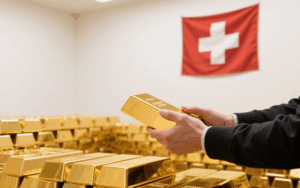
For gold, the proof case came in 2022, when Western governments froze roughly $300 billion of Russia’s overseas reserves — while the gold Moscow kept at home stayed out of reach. Kitco News calculates Russia’s roughly 73.2 million ounces are worth about $165 billion more today; Rickards puts Russia’s mark-to-market profit at more than $150 billion.
Central banks keep a floor under the metal. Official buyers have purchased roughly 1,000 tons a year for four straight years, and the People’s Bank of China reported 2,387 tons in August — its 22nd consecutive monthly increase — even as Beijing’s Treasury holdings slid to $618 billion, the lowest since 2008. Central banks won’t drive the spikes, Rickards says, but they cap the downside: an asymmetric trade.
His one caveat: futures, unallocated gold, options and ETFs are contracts, not gold. Only the physical metal counts.