Orion Minerals has cleared a key financing hurdle for its Prieska Copper Zinc Mine restart in South Africa’s Northern Cape. The company said on 19 October 2026 that its US$40m Tranche A financing from Glencore is now unconditional after final concentrate offtake and intercreditor agreements were executed and all conditions precedent were satisfied. First drawdown is expected by the end of October 2026, which should allow development contracts, site mobilisation and early construction work to move ahead.
The latest announcement matters because it turns a signed financing package into executable funding. For a mine development story, that distinction is important. Until a tranche becomes unconditional, the project cannot reliably convert paperwork into earthmoving, procurement and plant construction. Orion’s update means the first slice of capital is now available, but the wider funding structure is not yet complete. Tranche B, worth US$210m, remains conditional and is tied to development of the Deeps mine.
That leaves the market with a clearer path for the Uppers project and a longer-dated funding requirement for the deeper orebody. Investors should read this as progress, not completion. The company has crossed one major gate, but the project still depends on executing the next stages on time and within budget, while keeping the broader financing and operating plan intact.
The arrangements were entered into by Orion’s subsidiary, Prieska Copper Zinc Mine (Pty) Ltd, under agreements announced on 9 February 2026. The offtake structure is commercially important because it gives the project a defined route to market. Glencore will purchase 100% of Uppers bulk concentrate for five years and 100% of Deeps copper and zinc concentrates for a minimum of 10 years. That reduces selling uncertainty for the project, although it does not remove technical, execution or funding risk.
Orion also said the first copper and zinc production from the Uppers Mine is targeted by the end of 2027. That timing is later than some earlier guidance circulated in February, but the company’s 19 October 2026 statement is the current target in the record reviewed here. The timing shift was not explained in the available sources, so it should be treated as a change in target rather than a confirmed delay with a stated cause.
Operationally, the company has started lining up the people and equipment needed to turn funding into construction. Torque Africa has been appointed as drilling contractor, and ENPROTEC has been selected to deliver the 20,000 tonnes-per-month Uppers concentrator under a build-own-operate-transfer arrangement. Those selections matter because mine restarts are usually won or lost on practical execution: access to competent contractors, reliable plant delivery and disciplined ramp-up planning.
A 20,000 tonnes-per-month concentrator is a meaningful processing unit for a restart project, but throughput alone is not enough. Investors will want to see whether the company can keep engineering, procurement and construction on schedule, especially as it moves from a funding announcement into field work. The presence of named contractors suggests the project is advancing beyond concept, yet the real test will be whether mobilisation, installation and commissioning happen without major slippage.
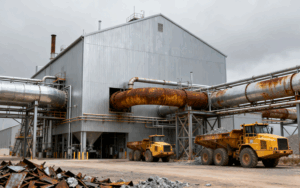
Prieska is not a greenfield idea. Near Copperton, it is a volcanogenic massive sulphide deposit, a style of mineralisation often associated with copper, zinc and other base metals. The project also has a production history, having yielded 430,000t of copper and about 1m tonnes of zinc under Anglovaal from 1971 to 1991. That matters because past production confirms the district has generated economic metal volumes before, even if the modern mine plan still has to prove itself under current cost, regulatory and technical conditions.
For investors, the existing geology can be a positive because it reduces the amount of uncertainty versus an untested discovery. But history does not guarantee future performance. Old mines can be attractive restart stories precisely because the geology is known, yet they also carry legacy issues such as infrastructure refurbishment, geotechnical complexity and the need to align old workings with modern mine design. Prieska’s history is encouraging, but the economic case still has to be rebuilt with current capital and operating assumptions.
The most constructive reading of the announcement is that Orion has moved from funding discussion to near-term action. The unconditional status of the US$40m Tranche A should support visible activity at site and give the company a stronger platform to advance development contracts. If the first drawdown lands by the end of October 2026, the market should begin to see whether the project team can translate financing into measurable progress.
At the same time, the bigger funding item is still outstanding. Tranche B at US$210m remains conditional, and that is the capital likely needed to push the project deeper into full mine development. This is the main red flag in the story: a successful Tranche A drawdown does not eliminate the need for additional financing later. Any restart project can stall if later-stage capital, technical work or timetable assumptions fail to line up.
Glencore’s role gives the project more commercial structure than many junior mining restarts have. The company’s statement that it will buy the Uppers concentrate for five years and the Deeps concentrates for at least 10 years provides a clear off-take pathway. In practical terms, that can support financing discussions and make the development case easier to underwrite. It also signals that a major metals trader sees a route to future supply.
Still, investors should avoid reading an offtake agreement as a guarantee of success. Offtake supports the sales side of the model, but it does not solve mine development risk, operating cost risk or metallurgical risk. The company still needs to build and run the concentrator, manage mining operations, and achieve production targets in a region where logistics and infrastructure execution will matter. Those are the issues that determine whether a restart becomes a durable producer.
Tony Lennox, Orion Minerals’ managing director and chief executive, said: We are delighted to have concluded the financing and offtake agreements with Glencore, marking a major milestone for Orion and a pivotal moment in our transition from explorer to developer and producer. The language is typical of a company that has spent years moving a project toward bankable development, but the underlying point is valid: this is a transition stage, not a finish line.
Glencore’s Toby Spittle struck a similar tone, saying: We are pleased to assist Orion Minerals with financing for it to bring Prieska back to life and become South Africa’s next copper producer. That is a supportive statement, but investors should treat it as a counterparty endorsement rather than independent proof that the project will meet its targets. The practical test now shifts to site work, drawdown timing and project execution.
The next checkpoint is straightforward: whether the first drawdown of the US$40m Tranche A occurs by the end of October 2026. After that, investors should look for evidence that key development contracts have been let, site mobilisation is underway and construction activity is visible. The longer-term milestone is first copper and zinc production from the Uppers Mine by the end of 2027.
If Orion can hit those steps, the market will have more confidence that the Prieska restart is moving from funding milestone to operating asset. If it slips, the current announcement will still matter, but mainly as a reminder that mine restarts are measured in stages, not headlines. For now, the company has secured an important financial bridge. The harder part is turning that bridge into a working mine.