
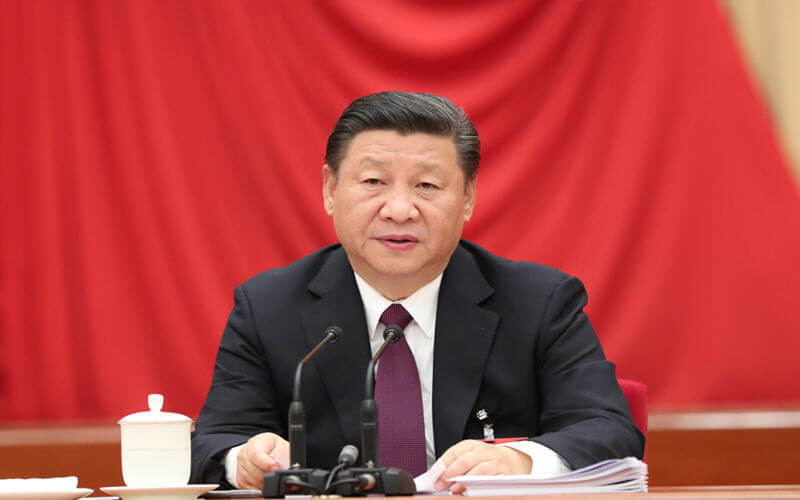
No event on the political calendar of any big country features the same mix of anticipation and mystery that accompanies the Chinese Communist party’s congress. The main purpose of the event — held once every five years — is personnel selection. About 70 per cent of the 350-member Central Committee, the 25-member politburo, and the Politburo Standing Committee — which has seven members at present — are due to turn over.
Few would deny that who rules China for the next five years matters for the economy and financial markets, but figuring out how is another matter. Even if a list of the next standing committee were leaked today, the implications for policy would remain highly uncertain. To call congress interpretation an inexact science would be charitable.
“This is more of a political event rather than an economic policy event. Even though politics dominates economics, it will take time for political doctrine and guidance to be translated into specific policies,” said Thomas Deng, chief investment officer at UBS Wealth Management in Hong Kong.
Despite its fundamental inscrutability, Chinese financial markets will be watching the party congress closely for clues about monetary policy, capital controls, and state-owned enterprise reform, among other themes. Herewith, we present three themes to watch during the congress:
1. Stability
Whatever the medium- and long-term implications of the changes ratified at the congress, mainland markets are expected to be highly stable during the roughly week-long event.
Much as they did during the stock market rout of mid-2015, authorities will pull out all the stops to counteract any embarrassing declines in big indexes or the renminbi exchange rate that would disrupt the image of strength that the party intends to project during the proceedings.
In the stock market, the so-called “national team” of state-owned investors will be on high alert in case a backstop is needed. At previous political events such as the annual parliament session, regulators have also delivered oral guidance to brokerages and mutual funds, instructing them not to sell.
Similarly, the People’s Bank of China will use open-market operations to ensure ample liquidity in the interbank money market to avoid any hint of a cash squeeze. The PBoC will also stand ready to deploy the country’s $3.1tn in foreign exchange reserves to support the renminbi exchange rate, if necessary.
Even after the congress, most analysts expect a continuation of the policy framework developed over the past five years, though some anticipate that implementation will improve if President Xi Jinping is able to install loyalists in key positions.
“Regardless of the political outcome, don’t expect any big shifts in economic policy. The broad strokes of policy have been in place for a while and are likely to continue,” wrote Arthur Kroeber, partner at Gavekal Dragonomics, a Beijing-based research company.
2. State-owned enterprise reform
Raising efficiency at China’s lumbering state-owned enterprises (SOE) has been a stated priority for Communist party leaders for the past four years, but until recently there was little sign of concrete action. Now the effort appears to be accelerating.
The partial privatisation of telecom carrier China Unicom is a signal that so-called “mixed ownership” reform will be an increasingly important element of SOE reform, even as critics argue that partial stake sales may do little to influence corporate governance.
Strengthening SOEs through state-orchestrated mergers is another policy trend, as Beijing seeks to create globally competitive national champions in key sectors. Rhetoric emphasising SOE restructuring could spark speculative buying of groups in steel, electricity, chemicals and other sectors where mergers are expected.
Huang Xiaoming, partner at Preston Asset Management, a Shanghai-based hedge fund, says that a simple investment strategy of buying the industry-leading companies in each sector — most of which are SOEs — has yielded above-average returns since the beginning of 2016.
“The strong performance of the industry leaders partly reflects market forces, but to some extent also reflects the pricing in of these political factors,” he said.
3. Monetary policy
For years, China has sought to strike a balance between supporting growth and curbing excessive debt.
This year, with the annual growth target comfortably within reach, emphasis has shifted towards deleveraging, and the country’s debt load has stabilised. Yet uncertainty remains about how much monetary tightening authorities are willing to pursue, given that growth now appears to be slowing.
At the congress, indications of a more hawkish stance — or alternatively, concerns about a growth slowdown — could affect short-term interest rates. Still, analysts generally expect money-market rates to be rangebound, as the tenor of monetary policy has already been well communicated.
“Any attempt to lower short-term rates will raise concerns about credit growth at a time when China’s leaders are seeking to prevent a further rise in leverage ratios,” wrote Song Yu, Beijing-basked chief economist at Gao Hua Securities, Goldman Sachs’ joint-venture investment bank. “On the other hand, a significant rise in short-term rates would generate concerns about growth.”
Source: www.ft.com