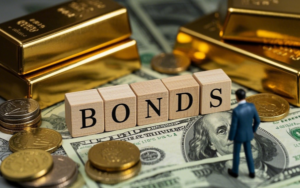

In order to hedge against geopolitical and recessionary risks, investors have flocked to the classic ‘safe haven’ of gold, driving the price up 44 per cent over the past 12 months to a record $2,942 per ounce this week.
In fact, the precious metal’s rise over the past year has even outpaced the ‘Magnificent Seven’ US technology stocks.
The historic rebound in the price of gold does not just represent a renewed upturn in commodity prices, but may also signal a fundamental shift in the way investors preserve their wealth in a time of growing economic uncertainty. More and more investors are turning to gold, an old and stable investment vehicle, to protect their portfolios.
And for those who have been watching from the sidelines and missed the opportunity to see the big rise in the price of gold, now might be the perfect time to add gold to their portfolios for three obvious reasons:
Firstly, although gold has risen sharply to near $3,000 per ounce, the current price level may actually be an attractive buying point for investors. Since January 2025, gold has shown consistent upward momentum, with each small pullback followed by a strong rally. Moreover, the current price action is likely part of a larger bullish trend rather than a temporary spike.
Unlike some of the volatile jumps seen in past gold rallies, the steady nature of this year’s price growth could signal a more sustainable upward trajectory. If this is true, then today’s gold price could be the lowest for some time to come.
Secondly, inflation, which cooled off significantly for much of 2024, is picking up again in January 2025, with the U.S. Consumer Price Index (CPI) rose 0.5%, the fastest rate of increase in more than a year. Year-over-year inflation is still at 3.0%, exceeding the Fed’s 2% target.
As inflation accelerates, the purchasing power of traditional currencies declines. However, gold has historically been able to hold its value in times of inflation and typically appreciates when other assets struggle.
This is because paper money can be devalued through monetary policy decisions, but the intrinsic value of gold remains intact. The precious metal’s limited supply and general acceptance as a store of value also makes it particularly effective at maintaining purchasing power when inflation erodes the value of traditional financial assets. Therefore, if one wants to protect wealth from the erosion of rising prices, it is wise to invest in gold now rather than in other more volatile assets.
Last but not least, the current economic environment is characterised by extraordinary uncertainty, driven in large part by policy changes proposed by the new US administration. These changes are likely to have a significant impact on, among other things, tax structures, regulatory frameworks and government spending patterns, and as a result traditional investment strategies may need to be reassessed.
Gold has historically been a stabilising force in portfolios during times of economic and political transition, often moving independently of other asset classes and providing a crucial diversification advantage as markets react to policy shifts.
Moreover, when the economic outlook is fraught with uncertainty, the precious metal’s role as a safe-haven asset becomes particularly important, by providing an insurance policy against potential market disruptions. Therefore, if one wishes to gain the protection that precious metals can provide in today’s unusual economic environment, it remains wise to buy gold now.