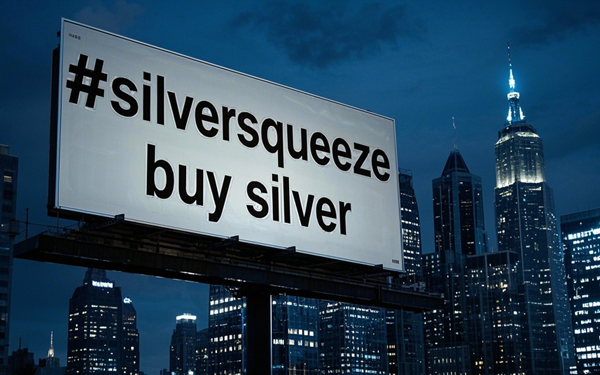
Recently, social media has been abuzz with talk of a “Silver Squeeze 2.0” movement. Retail investors are planning to challenge the control of large financial institutions over the silver market by collectively buying physical silver. Some analysts have accused major financial players, such as JP Morgan and UBS, of using “naked shorting” tactics to suppress silver prices for years.
These institutions currently hold net short positions amounting to 223 million ounces of silver. If the price of silver were to rise by $1, they could incur $223 million in losses.
This movement bears similarities to the “Silver Squeeze” of 2021, but the market conditions have changed since then.In 2021, retail investors briefly pushed silver prices above $30 per ounce. However, due to a lack of sustained momentum, the trend failed to continue. Supporters of the current movement argue that if retail investors focus on purchasing physical silver, it could tighten the supply chain, force short sellers to cover their positions, and drive up prices.
Despite this, some market experts remain skeptical. David Morgan, founder of The Morgan Report, highlighted that interest in silver among retail investors isn’t as strong now as it was in 2021. He also notes that silver prices have already risen significantly, making a repeat of the earlier surge unlikely in the short term.
An even more debated topic is whether silver prices can surpass $100 per ounce. Keith Neumeyer, the CEO of the Canadian mining company First Majestic Silver (TSX:FR, NYSE:AG), is a long-time silver bull. He believes silver prices could eventually reach triple digits, citing multiple factors including:
As of now, silver prices have surged past $34 per ounce, marking a 16% increase this year alone. In the short term, key driving factors include the Federal Reserve’s interest rate policies, the strength of the U.S. dollar, and geopolitical developments. In the long term, rising industrial demand combined with silver’s investment appeal could provide further price support. Some forecasts, such as those from InvestingHaven, suggest that silver prices could reach $49 by 2025 and potentially $82 by 2030.
Although the success of “Silver Squeeze 2.0” is uncertain and silver reaching triple-digit prices remains a significant challenge, interest in the metal continues to grow. Investors should balance considerations like industrial demand, monetary policy, and market sentiment, all while staying mindful of silver’s high price volatility.
If the supply-demand deficit persists, silver could undergo a revaluation. However, this pathway is likely to be characterized by intense market competition and uncertainty.