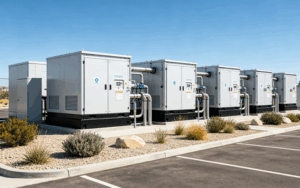

The paradox is simple enough to put in one line: the technology pitched as efficiency incarnate is running on a power diet that looks anything but efficient. Hyperscale data centers now soak up municipal-scale electricity and industrial-scale water, while households stare at rate hikes and utilities scramble for capacity they cannot build fast enough. Markets keep rewarding compute, but the scarce asset is the electron.
Across the U.S., utilities report load growth they have not seen in decades. Hundreds of new hyperscale sites have come online in two years, many clustered in states that once marketed cheap land and permissive permitting as a kind of economic development. The infrastructure was never designed for this. In Indiana, an Amazon-owned complex supporting Anthropic already draws at least 500 megawatts, with full buildout projected to rival the power needs of two midsize cities. Nationally, research groups estimate data centers could consume up to 9 percent of U.S. electricity by 2030, more than double today’s share. People notice when the bill arrives: household rates are up around 10 percent this year, and data centers are a material driver. The friction is now visible in town halls from Arizona to Virginia. Early goodwill is turning to opposition once communities learn that the jobs are few, the tax base is light, and the grid upgrades show up as a surcharge.
These sites do not only demand electricity; they demand water sufficient to cool acres of compute. Drought-prone regions with fast permitting look cheap until a heat dome arrives. Cooling systems pivot to more power-intensive methods, grids run hotter, transformers approach thermal limits, and small design choices compound into big failure modes. This is fragility in the Nassim Taleb sense: the system absorbs variability poorly and breaks in clusters. The industry’s preference for megacampuses, co-located with limited transmission redundancy, amplifies single-point-of-failure risk. History has seen this movie. Aluminum smelters once parked next to hydropower dams in the Pacific Northwest saw curtailments when reservoirs dropped. Crypto miners chased cheap power to similar dead ends. Moving bits is easier than moving electrons; latency constraints in AI have now pulled compute closer to population centers, where congestion already impedes growth. Investors who assume water and power are fungible inputs are underwriting a correlation they will not like during the next heat wave.
For a decade, markets treated “renewables plus batteries” as a predictable conveyor belt of new, cheap supply. That logic depended on policy continuity. A reversal of federal incentives for large-scale wind, solar, and storage is already showing up in delayed interconnections and fewer projects entering the pipeline after 2026. Geothermal is promising, but early-stage. Small modular nuclear is promising, but late-stage. Fusion is promising and always will be, until it is not. Meanwhile, the International Energy Agency expects the U.S., China, and the EU to drive 80 percent of new data center demand, even as trade friction slows equipment flows and raises costs. This is not a story of physics alone. It is institutional. U.S. transmission buildout takes a decade, not a quarter. Gas plants face permitting risk and volatile fuel costs. Coal plants are retiring faster than utilities can backfill firm capacity. Betting AI’s growth curve on an uninterrupted, cheap power glut is not a base case. It is a best case.
The valuation stack atop AI rests on a quiet assumption: power will be there, priced like 2019. That is a textbook free-energy fallacy. Training one frontier model can draw roughly 50 gigawatt-hours, but the real strain is inference at scale—billions of queries per day, 24 or 7, with latency demands that limit geographic arbitrage. This is a recurring balance-sheet problem misframed as an operating-cost footnote. If power tightens, cloud providers will outbid neighborhoods and small businesses for electrons, and the politics will turn. If they do not outbid, service degrades. In either branch, the assumption that “compute demand inevitably monetizes” meets its constraint. The opacity compounds the risk. Tech firms treat energy use as proprietary. Governments lack standardized metrics to audit it. Without disclosure, regulators cannot calibrate rates or resource plans, and investors cannot price the liabilities. When inputs are hidden, mispricing persists—until a shock forces repricing in a week instead of over years.
Think of the grid as a shared commons and AI developers as players in a repeated prisoner’s dilemma. Each firm has the incentive to pre-commit capacity—locking in power purchase agreements, interconnection queues, and substation upgrades—because the first mover gains optionality. Collectively, this hoarding behavior congests the system and raises costs for all. Utilities, facing rate-base incentives, are happy to build, but the lead times ensure supply lags demand. This is not a competitive market clearing in real time; it is a planning game with fat tails. The outcome resembles a tragedy of the commons with reservation rights instead of overgrazing. Meanwhile, rivals try to buy the same GPUs and the same megawatts. The firms that secure both will increase market share not because they wrote better code but because they cornered scarce inputs. Strategy devolves into energy arbitrage. When the critical bottleneck is power, the moat belongs to the utility or the generator, not the model.
The grid is an engineering system with thermal and frequency limits. Tail events push it into non-linear territory. Heat waves spike demand for cooling at the same time thermal plants derate and transmission lines sag. Drought crimps hydro and water-cooled data centers. Wind lulls arrive with high pressure. These are not independent risks; they are correlated. Add geopolitical risk to fuel supply or trade restrictions on power electronics and you compound the tails. The California energy crisis showed how market design flaws plus tight supply equals cascading failures. Europe’s 2022 shock showed how one node’s shortfall can ripple through a continent. The Institute of Internet Economics warns that if supply lags, brownouts become frequent and normalized. A fragile system looks stable—until it does not. The probability math here is simple: if a low-probability event is multiplied by a vast exposure, the expected loss is not small. It is systemic.
Antifragility in this context means AI grows stronger when the grid is stressed, not weaker. That demands design choices the market is currently avoiding. Workloads should shift in time and place: training during off-peak, inference routed to where renewable generation is abundant, not where land is cheap. Disclosure must become a condition of interconnection: standardized metrics for energy and water per unit of compute, verified by regulators, published for investors. Siting must price in water risk and local infrastructure limits, not treat them as externalities. Long-term, on-site power needs to be more than a press release. Geothermal where geology allows. Waste heat reclaim integrated with district systems. Storage sized for days, not hours, if claims of resilience are to mean anything. None of this is romantic. It is engineering and governance, the boring moats that last. If AI is the next general-purpose technology, it should be able to pass a basic stress test: can it thrive without assuming infinite, cheap power? If the answer today is no, then the fragile part of the story is not the model. It is the business model built on borrowed electrons.