
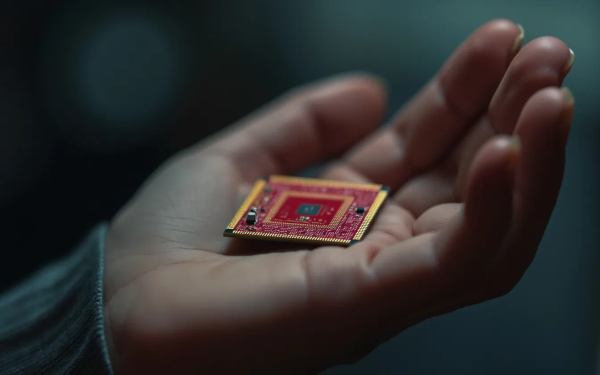
In a move ending months of uncertainty, the U.S. government, announced by President Donald Trump, will allow NVIDIA (NVDA) to resume sales of its H200 artificial intelligence chips to China. However, the approval comes with a significant condition: a 25% fee on each transaction, and it may have arrived too late to reclaim the market NVIDIA once dominated.
Trump announced the policy on his Truth Social platform, stating he had informed Chinese leadership and received a “positive response.” He emphasized the permission was granted under conditions meant to safeguard national security.
Under the new rules, NVIDIA can only sell the H200 chips to Chinese commercial clients approved by the U.S. Commerce Department. The U.S. government will take a 25% cut from each sale. The Commerce Department is finalizing the detailed arrangements, which will also apply to other U.S. chip companies like AMD and Intel.
NVIDIA responded to the news, calling the supply of H200 chips to vetted commercial customers “a positive move” that strikes a “thoughtful balance.”
From a product standpoint, the H200 chip itself represents older technology. It is based on NVIDIA’s Hopper architecture, which has been succeeded by the more powerful Blackwell chips, with the Rubin platform next in line. Trump explicitly stated that these newer generations are not included in the current license.
More critically, the market landscape has fundamentally shifted. Since U.S. export restrictions took effect, NVIDIA’s share of China’s AI chip market has plummeted from 95% to nearly zero. CEO Jensen Huang acknowledged in October that the company had “100% left the Chinese market,” calling its absence a “huge loss.” He estimated the Chinese AI market could reach roughly $50 billion in the next two to three years.
During NVIDIA’s absence, China’s domestic AI chip industry has accelerated. Clients have rapidly adopted alternative solutions. Executives from tech giants like Baidu and Tencent have recently stated they have significantly increased the use of homegrown chips. Zhou Hongyi, founder of 360 Group, also confirmed a procurement shift toward domestic products. Customer habits and supply chains have undergone a profound transformation.
Even with U.S. clearance, sales face regulatory uncertainty on the Chinese side. According to the Financial Times, Chinese authorities are preparing to impose usage restrictions on such imported chips to continue promoting the domestic semiconductor industry. Companies seeking to purchase them may need to apply for government approval, and bodies like the National Development and Reform Commission and the Ministry of Industry and Information Technology may implement conditions favoring local chips.
This means sales must navigate complex and potentially shifting regulatory requirements from both governments, adding significant variables to actual implementation.
The financial impact is nuanced. In April, when the U.S. restricted the China-specific H20 chip, NVIDIA estimated a potential quarterly revenue loss of about $8 billion. The H200, being more advanced and expensive, represents a larger theoretical opportunity. However, actual revenue recovery will heavily depend on subsequent regulatory battles and market acceptance.
Currently, NVIDIA stock trades at a forward price-to-sales ratio of about 25 times next year’s projected sales. While the license is a positive development, major questions remain about NVIDIA’s ability to regain its former share before China’s regulatory stance is clear and in a market now deeply penetrated by local competitors. This long-awaited “entry pass” may have arrived after the market’s doors have already swung toward other options.