
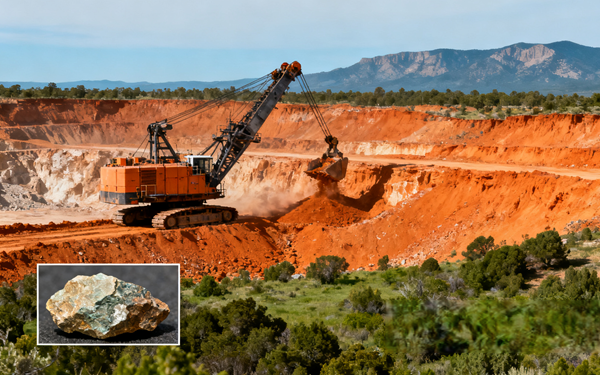
Shares of U.S.-listed rare earth and critical mineral miners rallied sharply on Tuesday, fueled by a major policy announcement from President Donald Trump. The surge followed the unveiling of “Project Vault,” a first-of-its-kind strategic minerals reserve designed to secure the private industrial supply chain.
The plan aims to pool $2 billion in private capital, backed by a $10 billion loan from the U.S. Export-Import Bank. “Today, we’re launching what will be known as Project Vault, to ensure that American businesses and workers are never harmed by any shortage,” Trump stated in the Oval Office on Monday.
The news provided an immediate boost to the sector. Critical Metals Corp (CRML) climbed more than 10%, USA Rare Earth (USAR) jumped nearly 11%, MP Materials (MP) gained about 4%, and NioCorp Developments (NB) rose close to 10%.
This rally is part of a broader trend that has taken hold since early 2026. Geopolitical tensions and aggressive U.S. policy shifts aimed at reducing dependence on China—which dominates rare earth processing and magnet manufacturing—have reframed critical minerals as a national security imperative. A wave of federal funding into domestic mining and processing projects is solidifying a new, policy-driven investment theme focused on supply chain sovereignty.
For investors navigating this space, which combines significant opportunity with notable risk, here are four key stocks representing different points on the value chain:
MP Materials operates the most advanced rare earth platform in the Western Hemisphere, centered on its Mountain Pass mine and processing facility in California. It is the only large-scale integrated rare earth operation outside China. The company reported a record 721 metric tons of neodymium-praseodymium oxide production in Q3 2025 and targets 60,000 metric tons of annual rare earth oxide capacity. Its vertical integration strategy, extending to magnet manufacturing in Texas, and a $400 million preferred equity investment from the Department of Defense in mid-2025 underscore its strategic role. While trading at elevated multiples, its scale, expansion plans, and policy support position MP as the sector’s blue-chip play.
USA Rare Earth is building a mine-to-magnet operation based on its Round Top project in Texas and a magnet plant in Stillwater, Oklahoma. Round Top is rich in heavy rare earth elements like dysprosium and terbium, crucial for defense and clean energy. The company recently accelerated its commercialization timeline and acquired proprietary separation technology. Speculation is high due to its CEO’s “close communication” with the Trump administration, suggesting potential for major government contracts or investment. USAR offers leveraged exposure to U.S.-China decoupling, with near-term revenue potential from Stillwater and long-term strategic value from Round Top.
Critical Metals is developing the Tanbreez project in southern Greenland, which holds substantial heavy rare earth deposits. The company has begun constructing a storage and pilot plant facility and secured $120 million in non-dilutive financing from the U.S. EXIM Bank. Its stock skyrocketed in early 2026 on renewed market speculation about the Trump administration’s interest in Greenland, gaining nearly 90% year-to-date. The investment thesis hinges on the strategic scarcity of its heavy rare earths. The stock offers high leverage to both project execution and geopolitical developments surrounding Greenland.
NioCorp is advancing the Elk Creek project in Nebraska, set to produce niobium, scandium, and titanium, with rare earth potential under evaluation. With $360 million in equity financing secured and board approval for initial construction, the project is moving forward. The acquisition of FEA Materials’ assets allows it to produce aluminum-scandium master alloys. NB represents a broader critical minerals investment theme aligned with federal supply chain diversification goals. Recent analyst initiation with buy ratings and clear 2026 catalysts around construction provide a focused timeline for investors.
In summary, these four stocks map the investment landscape emerging from forceful U.S. policy to build a domestic critical minerals supply chain. Each offers exposure to government-backed infrastructure development and operates in an industry where geopolitics and industrial policy are redrawing the competitive map. Investors should carefully weigh the operational stage, resource profile, and proximity to policy catalysts unique to each company.