
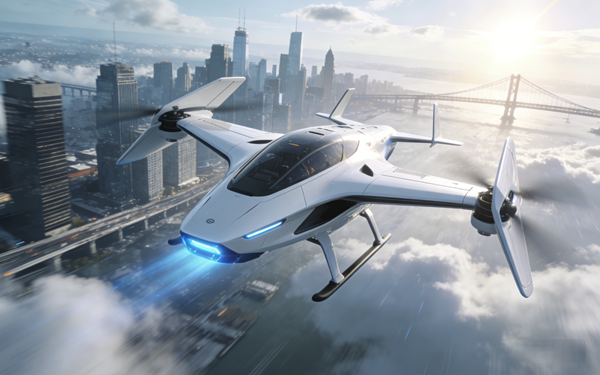
The prospect of flying cars whisking passengers across congested cities has long been the stuff of science fiction. But later this year, that fiction is scheduled to become reality in the skies above Dubai, and Wall Street is taking notice.
Electric vertical take-off and landing (eVTOL) company Joby Aviation (JOBY) and ride-hailing giant Uber recently announced plans to officially launch “air taxi” services in the Emirati city. The news not only marks the beginning of a countdown to commercializing a new mode of urban transport—it also suddenly expands the narrative—and the valuation potential—for both companies.
The inevitable question for investors: Is this the moment their stocks truly take flight?
Here’s how it will work: Uber users open the app, enter their destination, and if the trip qualifies, “Uber Air powered by Joby” appears as an option. With one tap, the journey is seamlessly booked—from an Uber Black car to the Joby aircraft, and another Uber Black at the destination to complete the trip.
This is more than just concept art. Joby’s all-electric aircraft is in the final sprint toward commercial launch. It’s designed to carry four passengers at speeds of up to 200 miles per hour, with a range of approximately 100 miles on a single charge. In Dubai, the initial network will feature four “vertiports” strategically located at key hubs: Dubai International Airport, a major shopping mall, a hotel on Palm Jumeirah, and the American University of Dubai. For routes that could compress an hour of gridlock into minutes of flight, the market potential is hard to ignore.
For Joby, the Dubai launch represents a critical milestone in its corporate lifecycle. As a leader in the eVTOL space, the company’s value has long been tied to its story and its potential. The transition to carrying its first paying passengers later this year means Joby will finally move from the research and development phase into business model validation. Successfully launching in Dubai wouldn’t just provide a blueprint for entering the U.S. and other markets; more importantly, it would demonstrate to the capital markets that flying cars are more than just slides in a pitch deck. They can be a real business generating revenue and building user loyalty.
For Uber, this partnership is another strategic move in its quest to become the “operating system” for everyday mobility. By integrating air travel, Uber is positioning itself to manage a user’s entire journey, from their neighborhood to the airport and beyond. Its deep integration with Joby gives Uber a prime position in the future of transportation without shouldering the massive capital expenditure and certification risks that Joby bears. Instead, Uber can monetize the trend through commissions, data accumulation, and increased platform stickiness. This “pick-and-shovel” approach—providing the marketplace for the innovators—looks particularly attractive in the current market environment.
However, before investors fasten their seatbelts for takeoff, a healthy dose of due diligence is required.
First, while the future looks bright, Joby’s financials tell the story of a company still in its early stages. In 2025, the company generated just over $53 million in revenue but posted a staggering net loss of nearly $930 million. Massive R&D investment, certification costs, and the need to build out manufacturing capacity mean that profitability is likely still years away. With a current market capitalization hovering around $9.8 billion, the stock already prices in a significant amount of optimism. Any delay in the commercial rollout or technical glitches could trigger sharp sell-offs.
Second, the regulatory “green light” isn’t fully lit. While Joby has entered the final stage of certification with the U.S. Federal Aviation Administration (FAA), no specific timeline has been provided for launching in America. A successful operation in Dubai will undoubtedly serve as a positive reference for U.S. regulators. Still, differences in aviation management systems mean that what flies in the UAE doesn’t automatically take off in the U.S. tomorrow.
For investors with a high risk tolerance, Joby offers a chance to bet on a groundbreaking technology just as it enters the commercial phase. The Dubai launch is a powerful short-term catalyst, but investing in Joby is ultimately a bet on a pre-revenue, capital-intensive company navigating an unproven market.
In contrast, Uber’s investment thesis may currently be more compelling. By building partnerships with leaders like Joby and Archer, as well as numerous autonomous driving companies, Uber is constructing itself as a super-aggregator for the future of mobility. It possesses both current profitability and a clear line of sight into tomorrow’s growth curves.
The launch of “air taxis” in Dubai will undoubtedly be a landmark moment in transportation history. For the stock market, it may also represent a dividing line between two investment philosophies: one chooses the high-risk, high-reward “aircraft maker” in Joby; the other opts for the stable, diversified “platform operator” in Uber. The right answer depends on the investor. But one thing is certain: the future is arriving, even if it isn’t evenly distributed yet. And as always, smart money is looking to position itself before it does.